With the right amount of light, your eyes stay alert, your mind stays alert and your work goes smoothly. Light determines how a space works and how it feels. In this guide, we delve into luxe and lumen so you can choose the right lighting for your home, office and special spaces.
What does the amount of light mean?
Light intensity and units of measurement
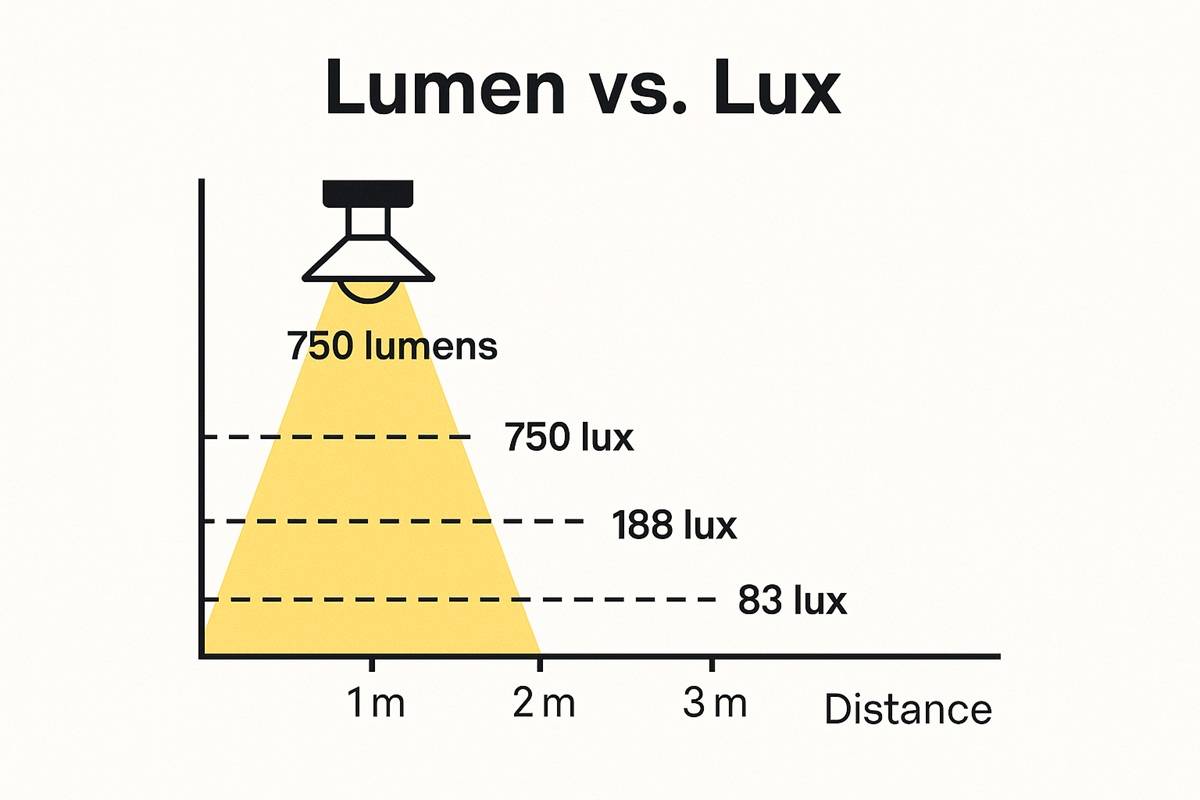
- Lumen (lm): the total amount of light produced by a light source.
- Lux (lx): the amount of light per surface area. 1 lx = 1 lm/m².
In practice, lumen tells you the "kick" of the lamp, lux how much light ends up on the work surface.
Natural vs. artificial light
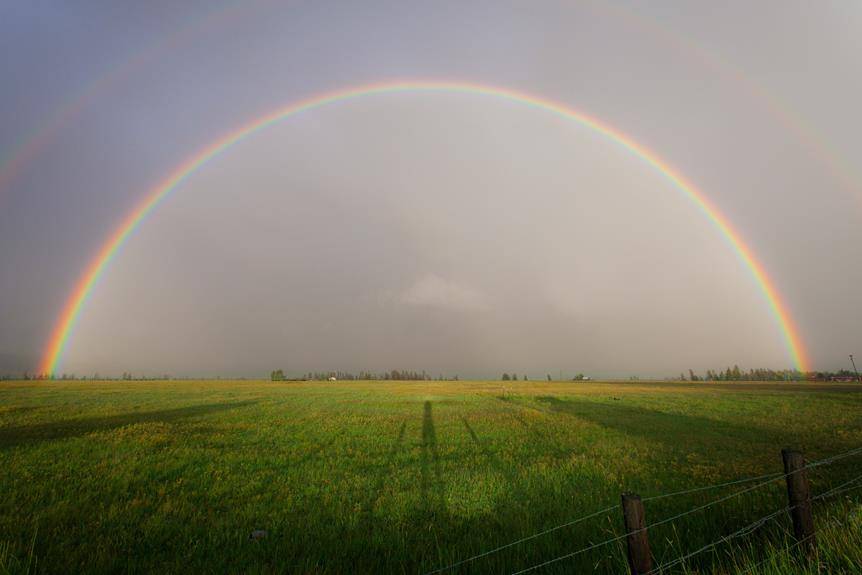
Natural light varies depending on the time of day and the season. It is pleasant and usually has excellent colour rendition. Artificial light ( LED, fluorescent, halogen) is controllable: you get the amount and colour temperature of light you want ( colour temperature controlled lighting, CCT) when you need it. The best result is achieved by combining these - plenty of daylight in from large windows plus CCT adjustable, glare-free LED lighting.
So that's it in theory. But we live in Finland... in practice this means that in summer we have light all the time and even have to darken our rooms to improve the quality of sleep (melatonin production is not possible in the light). So in summer, lights are rarely on in rooms with windows. In winter, on the other hand, we have lights on all the time no matter how big the windows are outside.
So in Finnish latitudes, windows are not given any added value in lighting design.
Lumens vs. lux - what is the difference?
| Term | Definition | Where to make use of |
|---|---|---|
| Lumen (lm) | Total light produced by the lamp | Comparison of lamps and lights |
| Lux (lx) | Amount of light per surface area | Measuring the lighting level in a given space |
Example: 1000 lm / 10 m² = 100 lx / m²
Recommended levels of luxury in different spaces
Below is a summary of recommendations (in line with typical EN 12464-1 levels and practices) to help you plan your daily life:
| Space / purpose of use | Recommendation (lx) | Design tip |
|---|---|---|
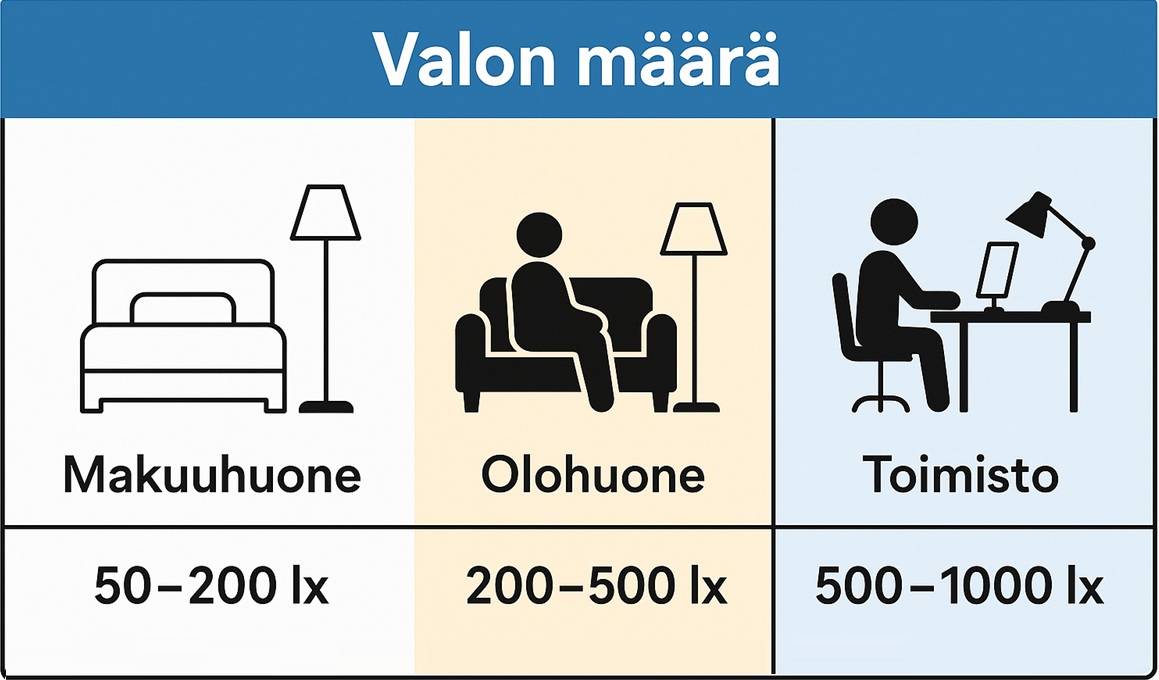
| Bedroom | 50-200 | Soft general light, reading light separately |
| Living room | 200-500 | Layered lighting, dimming |
| Kitchen worktop | 300-500 | Shadowless working light, high CRI |
| Office/workplace | 500-1000 | General light + adjustable work light |
| Bathroom/mirror | 200-500 | Steady, glare-free mirror lighting |
| Shop | 750-1000 | Accent lights for products |
| Industrial workshop | 1000-2000 | Very bright, flat |
| Greenhouse | 2000-10000 | Depending on the species and growth stage |
You can read a comprehensive article on UGR and other specifications of the EN 12464-1 standard
How do you calculate the lumens needed? - 5 ready-made examples with 033 CCT underlights
A quick way to calculate: choose a target lux for the space (see the room-specific table above) and size the number of lights so that the spotlights overlap evenly.
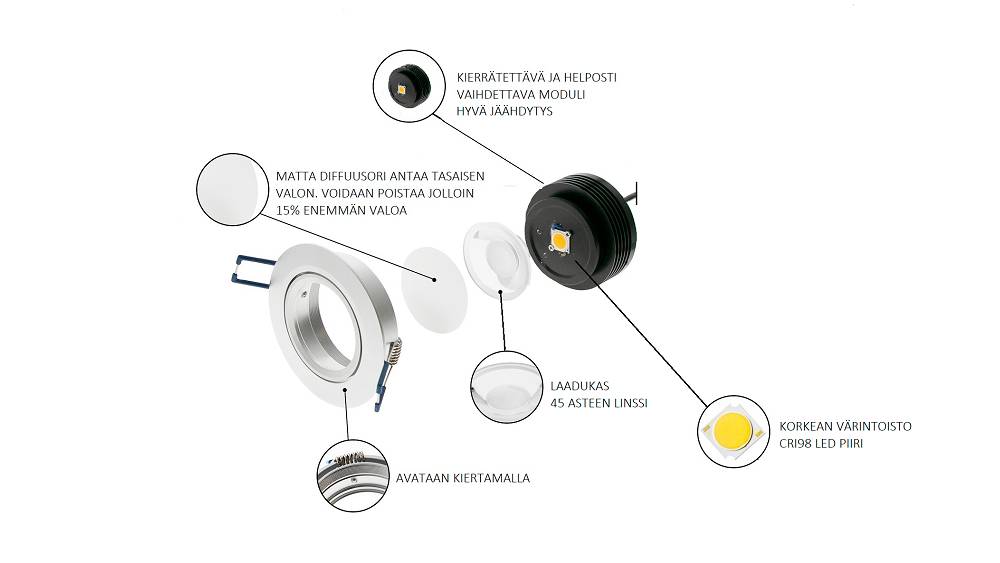
The point-lux of the 033 CCT is ~500 lx (110°) with diffuser and ~750 lx (45°) without diffuser. When the luminous flux is correctly estimated, the average lux of the whole space is typically 50-70% (110°) and 60-80% (45°) of these values.
1) Living room 20 m² - general lighting for a pleasant stay
- Target: 200-300 lx average.
- Recommendation 033 CCT: diffuser on (110°) for soft, glare-free light.
- Sizing: 6 units in a grid of 2.0-2.2 m spacing. 2.6 m ceiling → clear overlap of spotlights.
- Expected average lux: ~250-320 lx throughout the room for atmospheric light
- Complete: add a reading light or highlighter for whiteboards, etc. if necessary.
- Why: a wide 110° fills the space evenly; a diffuser softens shadows and reduces glare in the TV corner.
2) High space 30 m² (4.0 m ceiling) - kitchen-living room
- Target: 250-350 lx at floor level to avoid a dim feeling.
- Recommendation 033 CCT: without diffuser (45°) for better coverage and light hitting the floor.
- Size: 9-10 in a grid of 2,2-2,5 m spacing. Narrow wedge → less wastage to the sides in high space.
- Expected average lux: ~280-360 lx
- Fill in: highlight workstations by adding 1-2 more where brighter light is needed. Add glare-free task lights to workstations/work surfaces.
- Why is this: The 45° wedge keeps the light "together" and doesn't bounce up/down; the 750 lx point value helps compensate for height.
3) Bedroom 12 m² - quiet general light + reading areas
- Target: 100-200 lx general level, 300-500 lx in the reading range.
- Recommendation 033 CCT: diffuser on (110°) for general lighting. For reading areas, 1-2 units without diffuser (45°) directed.
- Sizing: general light: 4 units at 1.8-2.0 m spacing.
- Expected average lux: ~150-220 lx in general light; ~400-600 lx in the reading range in the centre of the beam without glare.
- Complete: reading lights: 2 with a narrow wedge on each side of the bed.
- Why: a wide wedge calms the space; a narrow wedge puts power only where it's needed (book page).
4) Kitchen 12 m² - shadowless working levels
- Target: 300-500 lx general level + 500-750 lx on worktops.
- Recommendation 033 CCT: General lighting with diffuser (110°), for worktops without diffuser (45°) aligned with the front edge of the cabinet.
- Sizing: general light: 4-6 units at 2.0 m intervals. Working levels: 3-4 narrow wedges 0,6-0,8 m apart, with the centre of the wedge about 20-30 cm behind the level (minimise shadows).
- Expected average lux: ~300-400 lx in room; on worktops ~550-750 lx in the wedge area (depending on distance).
- Why: the diffuser provides a pleasant background, the narrow wedge raises the lux to where the chopping and reading takes place.
5) Washroom / bathroom 6 m² - flat light + mirror
- Target: 200-500 lx general level; with mirror 500-700 lx, shadowless.
- Recommendation 033 CCT: General light with diffuser (110°); 1-2 units without diffuser (45°) on the mirror at an angle, or as top/side light.
- Sizing: general light: 3-4 units at 1.6-1.8 m spacing (small space → denser grid). Mirror: 1-2 pieces on a narrow wedge, oriented so as not to create "panda shadows".
- Expected average lux: ~250-400 lx in general; ~600-700 lx at the mirror.
- Note: Choose IP classes according to zones; the light from mirror lighting towards the face is important.
A quick refresher on choosing a spotlight
Want soft, glare-free general lighting? → use a diffuser (110°). Do you need power at a precise point (high space, flat work, mirror)? → use without diffuser (45°) and aim the beam precisely.
We have measured the actual light levels and opening angles of our lights. You can read more about the effect of light angle on illumination in the spotlight
Light levels in different environments
Interior
Flatness, glare control and surface reflections are important. Light, matte surfaces increase the perceived amount of light without adding power. Dark surfaces reduce the perceived (and measurable) amount of light.
Combining indirect lighting (LED strip lights) with direct lighting (spotlights/hanging lights) provides the best layered and functional effect. At the same time, a single light source does not need to be too powerful and dazzling when several light sources complement each other. Indirect light is sufficient for an atmospheric stay and by adding direct spot lights, you can create a party or cleaning light.
Outdoor spaces and weather conditions
When outdoors, remember your neighbours, especially in urban areas. A good example of a pillar light designed for the city is the FUNK Pillar, where the light only enters on 3 sides, so there is no direct light at all towards the neighbour.
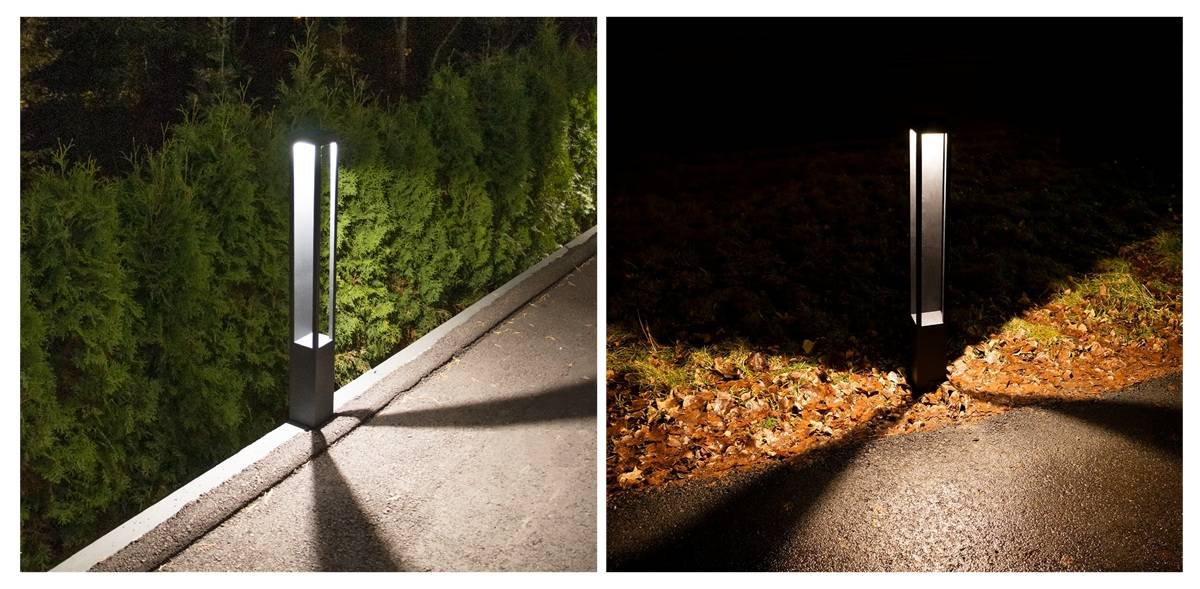
Nature also plays a role: cloud cover, snow and wet surfaces quickly change the light level. The dark and wet Finnish autumn is a miserable time. Rain and black surfaces eat up all the light. This is why, for example, spotlights on a tree or a rock should be powerful enough (+2000-5000 Lumen).
Special situations in the studio and in photography
In the studio, lux, light distribution and colour temperature are carefully controlled; in photography, shutter, aperture and ISO also affect image quality. Special lighting is therefore used in photography, always adjustable in terms of power and colour temperature. In addition, the colour rendering index (CRI) should be top class. The amount of lux required for photography is easily over 2000 lux!
Light levels and plant growth
Photosynthesis and light intensity
Plants need a sufficient amount of light for photosynthesis. Shade plants need less (e.g. 2000-5000 lx), light-loving plants need several times more. The length of the day (photoperiod) is also important.
Light spectrum and grow lights
Plants benefit from a balanced spectrum (blue for growth, red for flowering). Modern full spectrum LEDs give high light output and good efficiency - remember cool running temperatures and the right distance from the canopy.
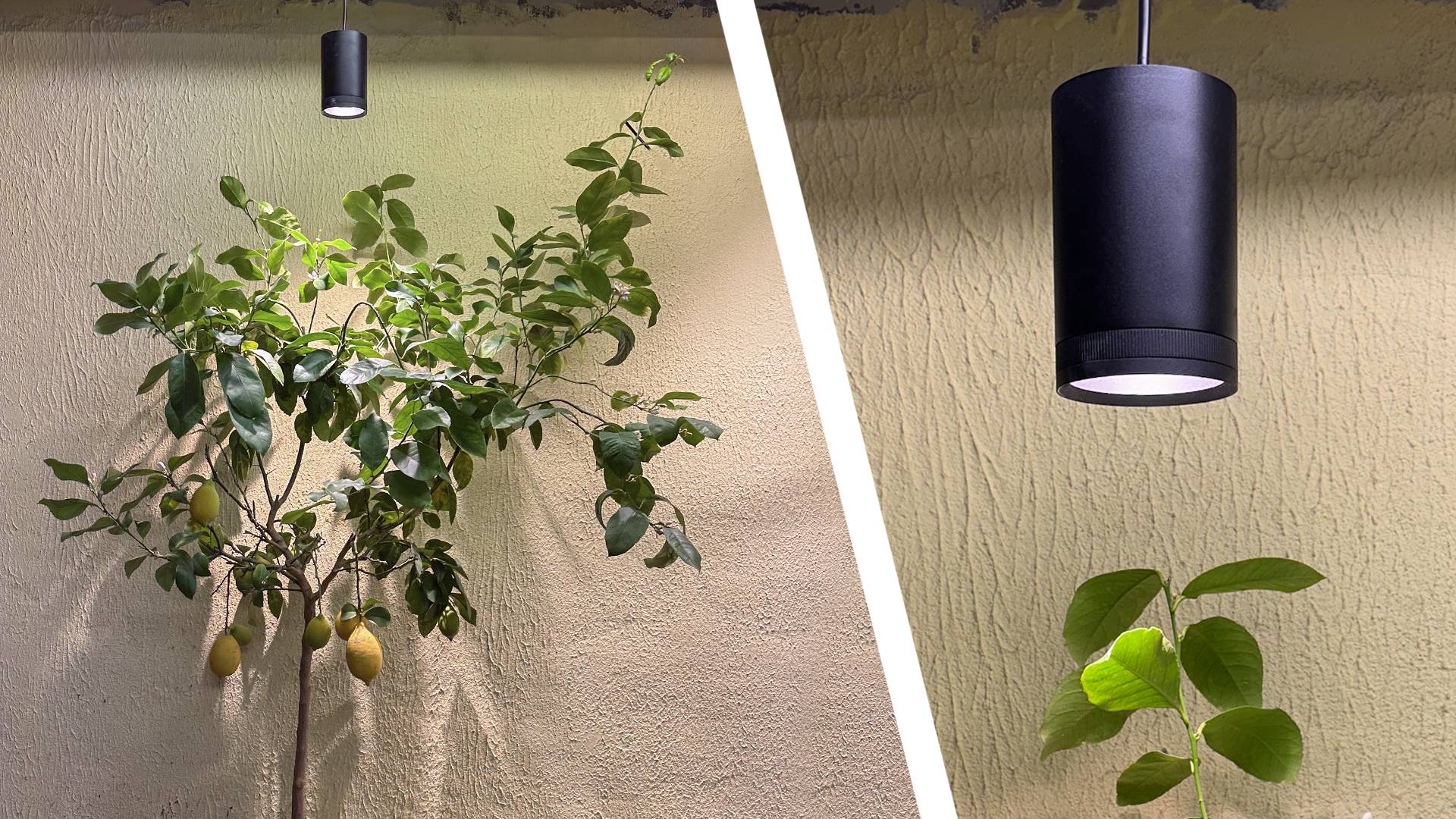
So you need a large amount of light and the right spectrum. High colour rendering lights with colour temperature control can provide excellent plant lighting. Read more about plant lighting here
How to measure the amount of light?
Lux meters and light sensors
A handheld meter is the most accurate tool for everyday use. Take measurements from several points on the work surface and average them; check for glare and shadows at the same time. Various smart home systems (e.g. Dali or Zigbee-based) always include light sensors.
Light sensors typically maintain the desired level by monitoring the amount of natural light in the room. For example, you can automate the switching on of certain lights when the lux level in a room falls below 200 lux. And at night, for example, you can minimize the amount of light when movement occurs so that too much light doesn't wake you up.
Smartphone apps
The phone's sensors give an indicative result. Useful for a quick survey, but final decisions should be made with a calibrated meter. Examples of such phone applications are "Lux Light meter English"
How to optimise the amount of light in your home and workplace
Making use of natural light
- Place the workstation in a side light (not directly in front of a window).
- Use light-coloured surfaces and translucent curtains.
- Take advantage of the light sensor and dimming: the amount of light remains appropriate without manual adjustment.
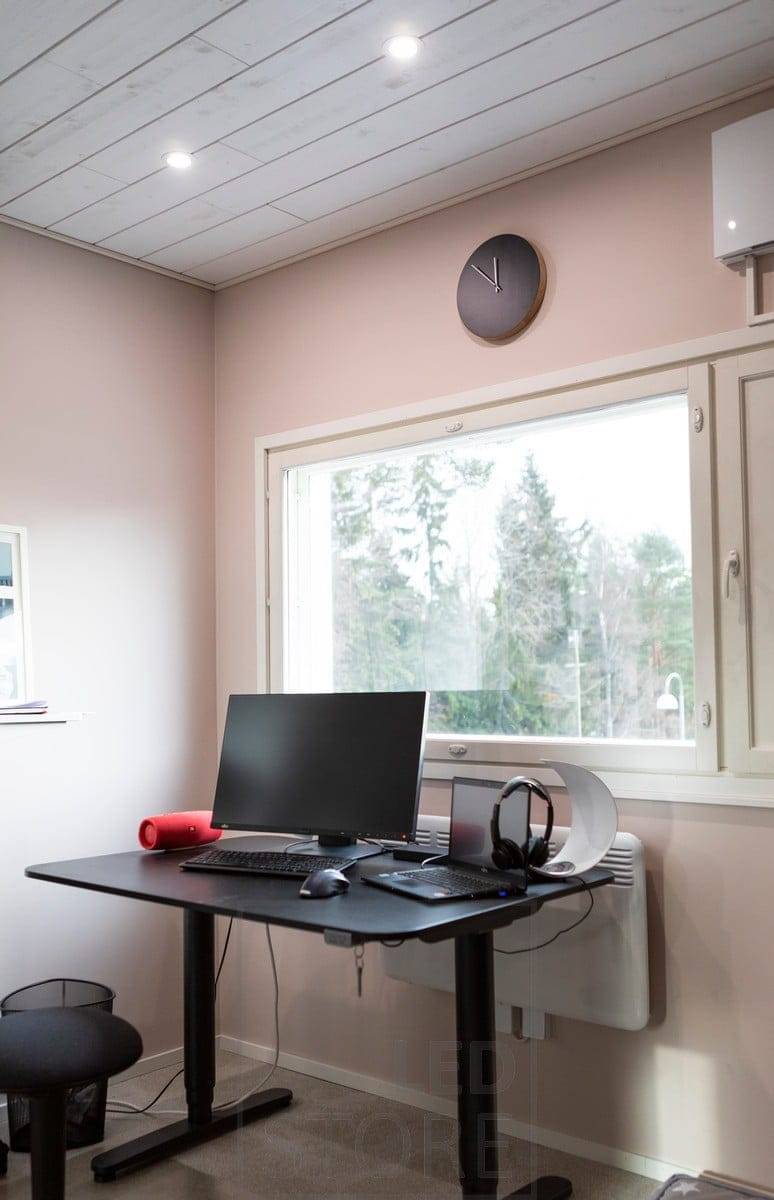
The right lamps and lighting solutions
- Choose a high CRI ( ≥90) so that the light is of high quality and not just light where the eye is not working properly.
- Take care of the light distribution of the light ( lenses/reflectors) so that the lighting works without glare.
The impact of the amount of light on everyday life
Vision and eye health
Too little light stresses the eyes and causes squinting and headaches. Excessive brightness or glare tires and impairs contrast discrimination. The best solution is the right lux level for work surfaces, low glare (UGR), even light distribution and good colour rendering ( CRI). Read more about how LED lights can reduce eye strain
Mood and well-being
Light regulates the circadian rhythm. Sufficient light in the morning is invigorating, while warm and dimmed light in the evening is calming. Bright light in winter can ease symptoms of chaos - avoid excessive blue light late at night. Read more about how led lights affect our circadian rhythms
Work efficiency and learning
Well-designed lighting levels improve accuracy and reduce errors. In offices, the combination works: 300-500 lx general light + 500-750 lx adjustable task light, allowing everyone to fine-tune the amount of light . Too often, local task lighting is left out and only general lighting is used, which is too low-powered. Read more about the importance of lighting for work performance
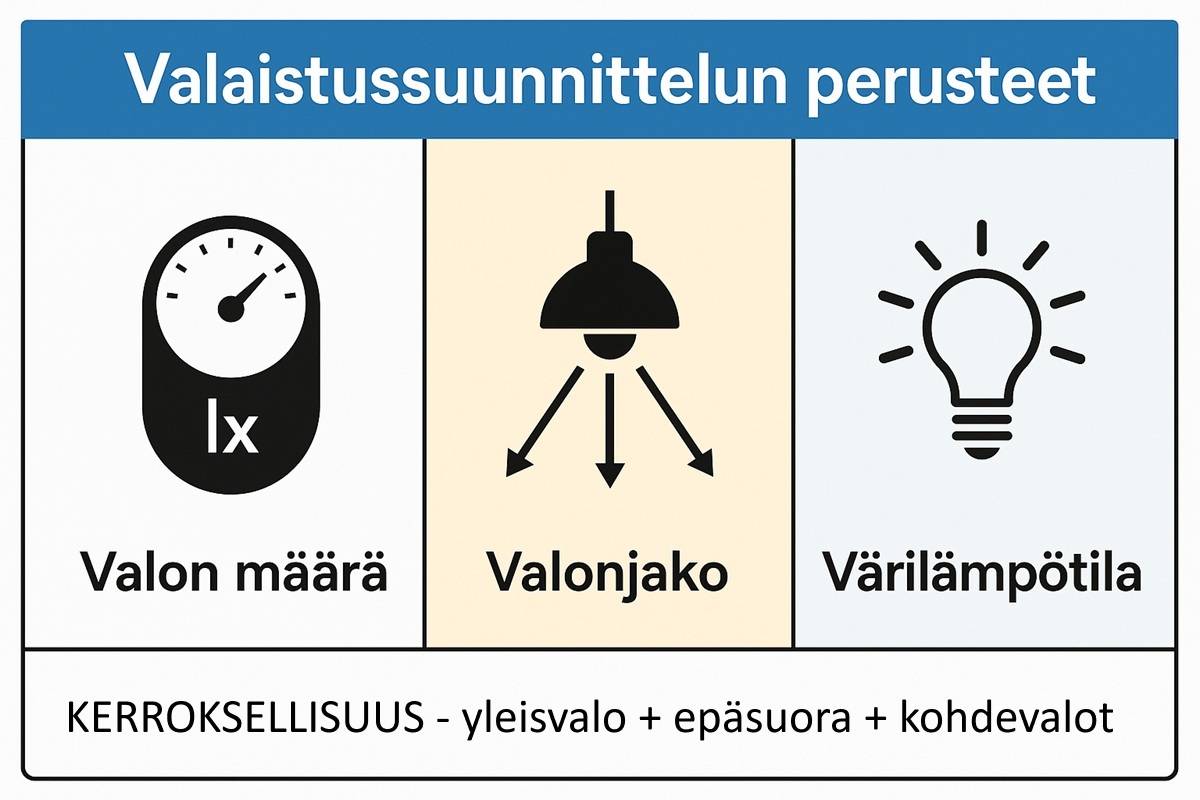
Lighting design basics
A good design combines: 1) amount of light (lux), 2 ) light distribution ( uniformity/glare), 3 ) colour temperature (2700-3000 K for relaxed, 4000-5000 K for work ). 4) multiple light sources (layering).
Common mistakes in managing light levels
- Rely on watts alone (doesn't tell you anything about lux).
- General lighting without spotlights → shadows on work surfaces.
- Light too cold for staying in or too warm for precise work.
- There is no dimming or control → the amount of light does not vary with the day.
- Glare and shiny surfaces are forgotten.
Future lighting technologies now
Human-centric lighting (HCL) is a system for controlling the amount and spectrum of light that supports human circadian rhythms. It supports the natural human rhythm (cooler in the morning, warmer towards the evening). Read more about the effects of Led light on our circadian rhythm
All this can already be controlled and automated with smart lighting such as DALI-2 or Zigbee.
FAQ - Frequently asked questions
- What is the right amount of light in a bedroom?
- Typically 50-200 lx. The reading light can be brighter (300-500 lx) when directed at the book, not the eyes.
- How many lumens for your living room?
- Multiply the m² of the room by 150-300 lux. For example 18 m² × 200 lx ≈ 3600 lm.
- How do I measure lux correctly?
- Place the meter on the work surface, measure at several points and average the values. Avoid shadows at the time of measurement.
- Is LED always the best?
- Yes: energy efficient, dimmable and a good range of colour temperatures. Choose CRI ≥ 92 for critical spaces.
- Can natural light replace everything?
- Not always. The dark season and evening work require artificial lighting - but it's best to make the most of natural light.
- Where can I find more about the units?
- See for example the Lux and Lumen articles
Summary
By learning how to apply the amount of light ( lux) and the light source output (lumen) to different spaces, you can improve your lighting: more comfortable, more efficient and more energy-efficient. Start with a target (lux) for each room type, calculate the lumens needed, choose lights that produce good quality light with good light distribution and control the light according to the situation - that's how your space works all year round in Finland.
Led lighting expert
LedStore has been an expert in LED lighting and lighting design for homes and offices since 2010. We have our own product design, and we manufacture LedStore products with selected producers, so the products are technically top class. We focus on temperature-controlled and high colour rendering (CRI) lights for general and task lighting.
We do around 500 lighting designs for our clients' sites, improving the usability and comfort of their spaces. Read more here or order a design.
We offer a service of custom-made LED strip lighting, i.e. individual, made-to-measure LED strip in aluminium profile for all home and office spaces. Also installed.
We serve builders and renovators, from consumers to contractors, wholesalers and designers. Our store, where all our lights can be seen installed, is located in the well connected Koivuhaas area of Vantaa, Mesikukantie 16, 01300 Vantaa.