The CRI index is more accurate than the Ra index
There is a difference in the colour rendering of light from LED lights in terms of CRI and Ra index. The Ra index measures colour reproduction using eight different reference colours, R1 to R8, while the CRI index measures shades R1 to R15. The Ra index therefore excludes bright reds, yellows and greens, as well as shades close to skin tone. In this latter part, R9 to R15, the light colours of LED lights have traditionally fallen short of a more modest result. In particular, R9, the red shade, has been a challenge for LED lights to reproduce properly.
The CRI therefore takes into account a wider range of wavelengths, including red and other warm tones. Ra index measurements focus on the blue and violet hues, from which the weighted average of R numbers 1-8 is calculated.
Red wavelengths (R9) have been difficult for LEDs to reproduce, which has accentuated the bluish tones and may have created a green veil or otherwise distorted the tones.
Improved colour rendering in LED lights
The colour rendering performance of LED lights has improved considerably and lights can produce a qualitatively more even wavelength distribution. Thanks to the improved colour rendering of light, LED lights can nowadays provide high-quality lighting that correctly reproduces the tones of the interior.
When choosing LED lights, it is worth paying attention to the CRI index. The closer the light's declared colour rendering index is to 100, the better the light quality. If the CRI is used and the colour rendering is above 90, it is likely that the red tones will also be reproduced excellently. However, it should be noted that if the colour rendering of a light is expressed in terms of Ra, the red (R9) may be poor because it is not measured at all in the Ra index.
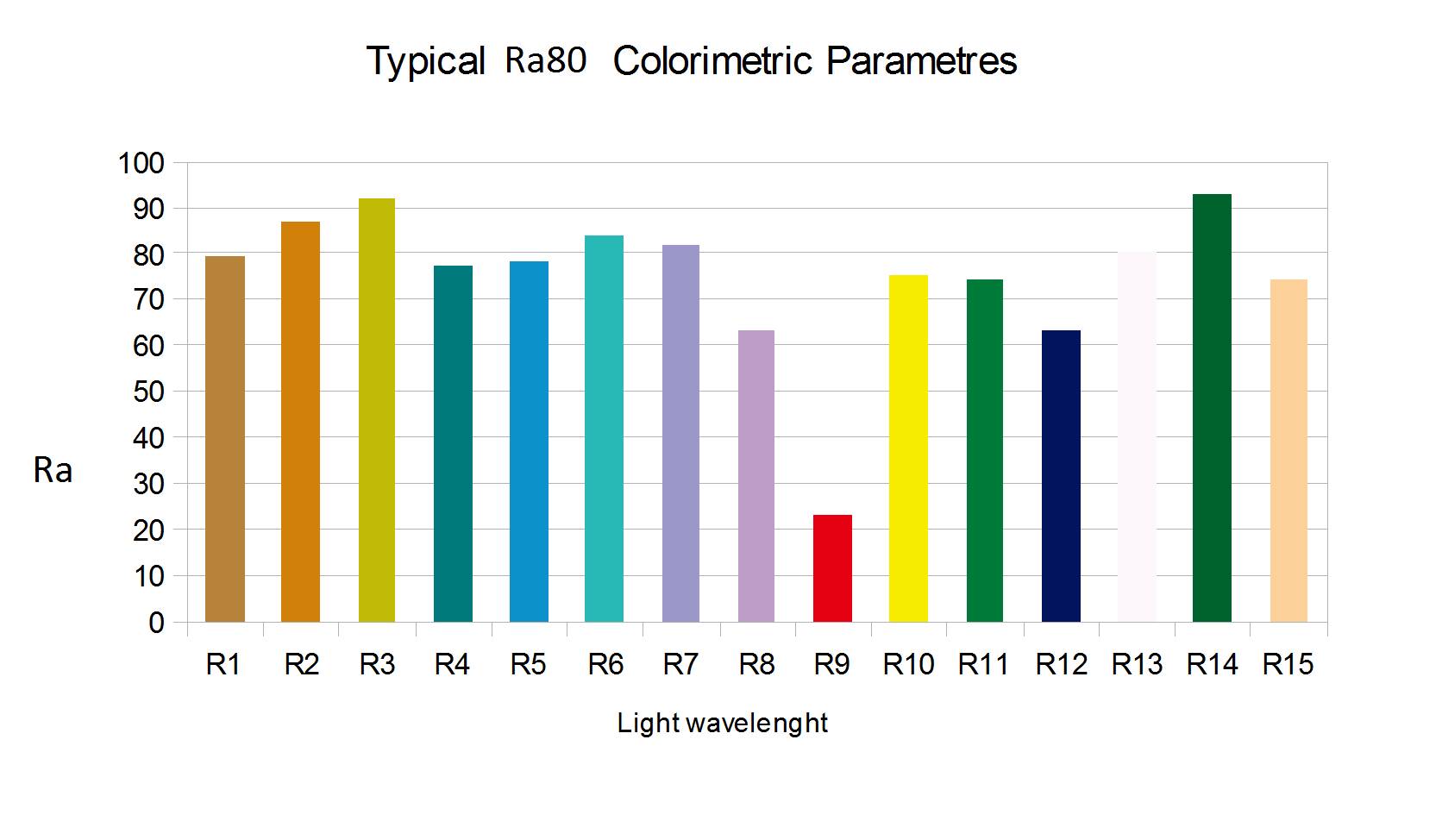
So if you want good colour rendering from your light, be careful with the CRI. It is not the same as the Ra index traditionally used to measure the colour rendering of light. As you can see in the diagram below, a Ra 80 light can only have a colour rendering index of about CRI 70.
Below are the measured values of one light R1-R15. The Ra index of the light is average and the red colour reproduction is downright poor. However, not all lights need to be at the top of their class in terms of colour rendering, but the light is always chosen on a site-specific basis. For example, in warehouses, lights with a lower colour rendering can be used.

Ra index vs. CRI index in brief
- The Ra index measures shades R1-R8 and the CRI index measures shades R1-R15.
- The Ra index does not measure the red hue of R9, which is particularly difficult for LED lights to reproduce.
- The CRI index gives more information about the quality of light from a LED than the Ra index.
- The Ra index of a light can be 80, while the CRI of the same light is only about 70.
1. Mitä CRI- ja Ra-indeksi tarkoittavat?
CRI (Color Rendering Index) and Ra (Rendering Average) are measures of a light's ability to reproduce colours. The higher the number, the better the colours in the interior, for example, will stand out naturally in the light of the light. These values are usually given on a scale of 0 to 100, and a value above 90 is considered excellent.
2. Onko CRI:n ja Ra:n välillä eroa?
Technically, CRI refers to the Color Rendering Index (CRI), which includes a number of test colors. In most cases, CRI is a CIE measurement of R1-R15 colours. The Ra index is the average of R1-R8 shades. However, in many cases the terms are used interchangeably and describe the same thing, i.e. the ability of a light to render colours naturally.
3. Miksi korkea CRI- tai Ra-indeksi on tärkeä?
A high CRI or Ra index ensures natural colours and a pleasant lighting environment. This is particularly important in areas such as kitchens and bathrooms where colours and details need to be seen clearly. In addition, furnishings, textiles and foodstuffs look better in high CRI light.
4. Mitä haittaa on, jos CRI- tai Ra-indeksi on alhainen?
A low colour rendering index can make colours look pale, blurred or even incorrect. Red can even look orange in low light. This is also distracting when the choice of colours for interior decoration has been made carefully or in hobbies such as painting and photography.
5. Miten valita valaisin, jolla on hyvä CRI- tai Ra-indeksi?
Check the CRI or Ra index in the light data. In general, a value above 90 is an excellent choice for rooms where colour rendering is important. By choosing quality LED lights, you can ensure that the lighting does not change the colours of your interior and is suitable for your needs. NOTE! You can find photometric measurements of all 15 R-values in the LedStore light link.