CCT-adjustable lighting is extremely popular. Almost every home we design includes adjustable lighting, and questions often arise when calculating power consumption. In this article, we explain the measured actual power of CCT LED spots and panels.
Why measure the actual power of CCT LED luminaires?
Often, a luminaire’s power is specified for only one color temperature (for example, “9W”), but CCT luminaires contain both a warm and a cool LED circuit. If both LED circuits are powered simultaneously without a CCT driver, the power consumption can be nearly double. In such cases, the luminaire may consume, for example, 18W even though the package states 9W. A CCT driver distributes power between the warm and cool LED circuits so that the total power remains constant.
When used incorrectly, a 9W CCT spotlight can in practice become an 18W luminaire – meaning that both the warm and cool LEDs are operating at full power at the same time.
This is not merely a theoretical risk: the luminaire’s electronics can be damaged by excessive current if the driver is not designed for such use. Therefore, the stated power consumption of CCT spots and panels already reflects the correct total input power.
CCT LED Spotlights – Actual Measurement Results
Below is a table of four recommended CCT spotlights. Each has been measured at three different color temperatures.
NOTE! The measurements for spotlights R023, R033, and SQ033 were carried out with an opal diffuser. The diffuser can be removed, which increases the total light output by approximately 10–15% and narrows the beam angle, allowing the light to project further (lux measured at 1 m). A common characteristic of all these luminaires is that the light source is recessed.
The 023 spotlight has a frosted glass lens that cannot be removed. In the 023 model, the light source is surface-mounted.
All measurements were carried out using a Zigbee CCT controller.
Product
Colour temperature
Power (W)
Luminous flux (lm)
CRI
R9
Lux 1m
Luminous efficacy (lm/W)
023
Warm white
9.3
577
97
99
750
62
Neutral white
9.3
688
95
96
891
74
Cold white
9.3
799
92
92
1032
85
R023
Warm white
9.1
481
98
99
196
53
Neutral white
9.1
563
95
96
229
62
Cold white
9.1
645
92
92
262
71
R033
Warm white
9.4
683
90
90
266
73
Neutral white
9.4
744
91
91
289
80
Cold white
9.4
804
91
92
311
86
SQ033
Warm white
9.1
558
90
90
207
61
Neutral white
9.1
639
91
92
236
70
Cold white
9.1
719
91
94
265
78
What did we learn from the LED spotlight results?
All spotlights remain within a power range of 9.1–9.4 W, meaning the driver is designed to operate only one circuit at a time.
Cool light produces up to 40% more light than warm light, as its luminous efficacy is higher.
All spotlights achieve a CRI above 90 – an excellent choice for indoor use and accurate color rendering.
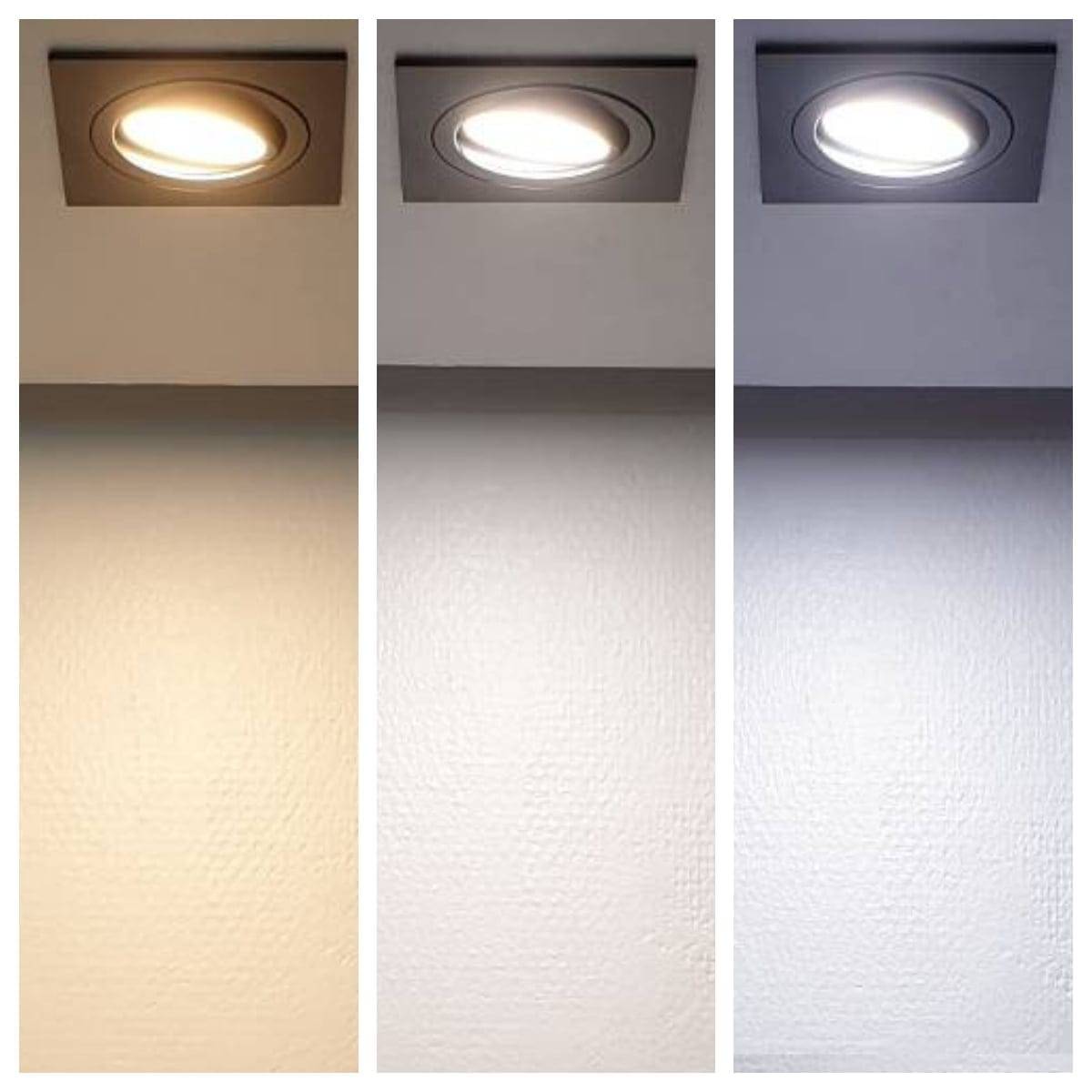
From left to right, the spotlights are in 2700 Kelvin, warm white, 4000K neutral white, 6000K daylight. NOTE! the colour effects of light are accentuated in the photograph and when placed side by side.
CCT LED Panels – Actual Measurement Results
Below are the measurement results for all tested panels. Various sizes are included (ø120 → 300×300 mm).
All measurements were carried out using a Zigbee CCT controller.
Product
Colour temperature
Power (W)
Luminous flux (lm)
CCT (K)
CRI
R9
Lux 1m
Luminous efficacy (lm/W)
Beam angle (°)
Plafond ø120
Warm white
6.5
477
3235
98
99
155
74
124
Neutral white
6.5
486
4236
98
94
158
75
124
Cold white
6.5
495
5236
99
92
161
76
124
Plafond ø160
Warm white
9.6
796
2658
97
99
243
83
129
Neutral white
9.6
871
4624
97
95
266
91
129
Cold white
9.6
945
6589
97
90
289
99
129
Plafond ø200
Warm white
15.2
1282
2896
98
99
403
85
127
Neutral white
15.4
1368
4192
98
99
430
90
127
Cold white
15.6
1453
5488
98
98
456
95
127
Panel 300x300
Warm white
15.6
1355
2736
97
987
379
87
131
Neutral white
15.6
1488
4617
97
98
405
96
131
Cold white
15.6
1621
6498
97
98
431
104
131
Panels: What does the data tell us?
In CCT panels, the power consumption clearly corresponds to a single LED circuit, rather than being the sum of both circuits.
The luminous efficacy is slightly better than that of the spotlights.
The CRI remains above 97 in almost all measurements, making them ideal for task and work lighting.
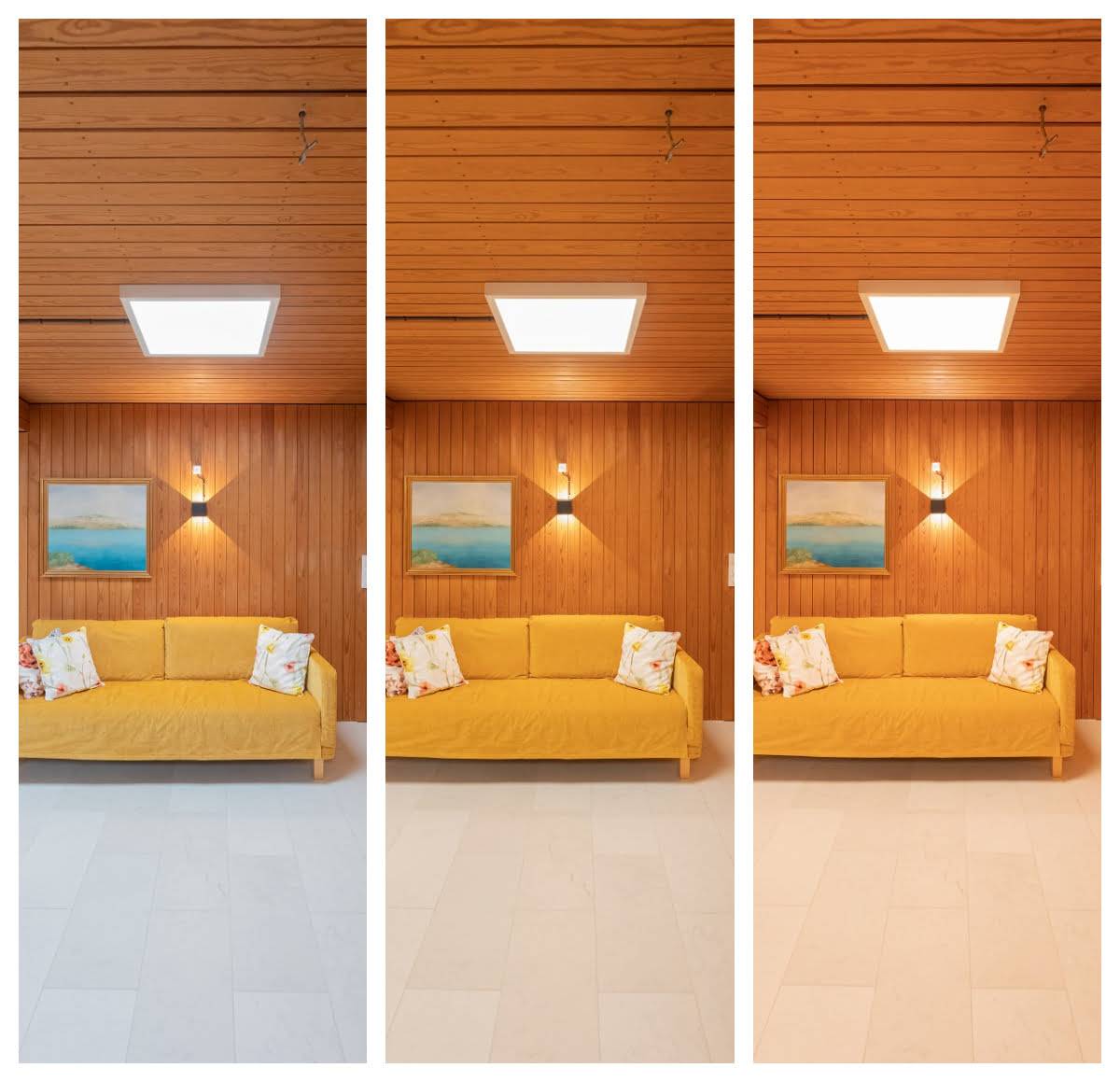
In a wood-panelled room, the shades of the wood, as well as the floor, change dramatically depending on the shade of white light you adjust from the panels.
Even if the controller allows it for a short time, a continuous 2x load will lead to overheating and failure of the components. So never connect hot and cold to the same terminal, but control should be done with transformers and reactors designed for CCT control. In the image, a CCT LED strip light is shown, with the wiring identical to that of CCT spotlights or CCT panels.
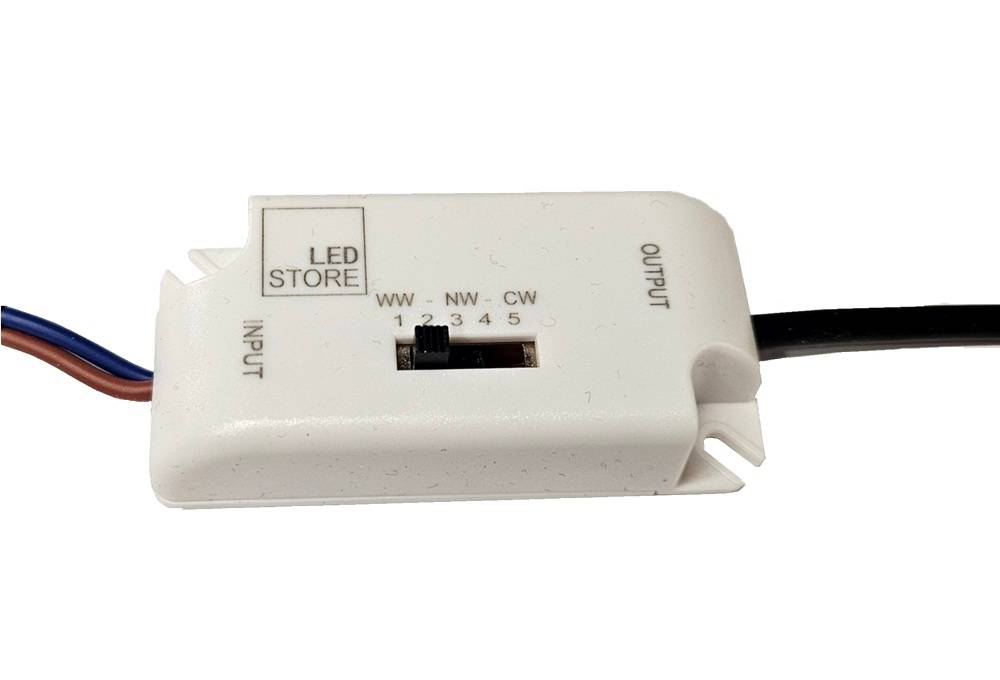
If the color temperature only needs to be set once and no control devices are desired, a slide switch can be installed in between to select the desired tone.
CCT slide switch for setting the color temperature during installation.
FAQ
Why isn’t the power of a CCT luminaire twice as high, even though it has two LED circuits?
Because the driver distributes the power between the circuits, preventing overload.
Is cool light always more efficient than warm light?
Yes. Typically, cool light (5000–6500K) produces more light at the same power level—about 5–15% more.
Can I combine warm and cool light to create a neutral tone?
Absolutely NOT! Only with a controller specifically designed for this purpose, which limits the current to the LED circuit. Otherwise, you will damage the LED circuit by overloading it.
How were the values measured?
All values were measured at a distance of 1 meter using a calibrated photometer.
Which luminaire is suitable for precise task lighting?
A luminaire with a CRI of >95 or higher and a high lux value – for example, a 300×300 panel or the 023 spotlight.
What happens if I overload a CCT luminaire?
Overheating and failure.
Summary
CCT luminaires offer adjustability and accurate color rendering.
The beam angle of a luminaire affects the lux levels, even when the lumen output is the same.
Well-designed lighting always provides the best solution for homes, offices, and public spaces.
LedStore’s customer service is always happy to help with questions and can handle even the most challenging technical issues!

 In a wood-panelled room, the shades of the wood, as well as the floor, change dramatically depending on the shade of white light you adjust from the panels.
Even if the controller allows it for a short time, a continuous 2x load will lead to overheating and failure of the components. So never connect hot and cold to the same terminal, but control should be done with transformers and reactors designed for CCT control.
In a wood-panelled room, the shades of the wood, as well as the floor, change dramatically depending on the shade of white light you adjust from the panels.
Even if the controller allows it for a short time, a continuous 2x load will lead to overheating and failure of the components. So never connect hot and cold to the same terminal, but control should be done with transformers and reactors designed for CCT control. 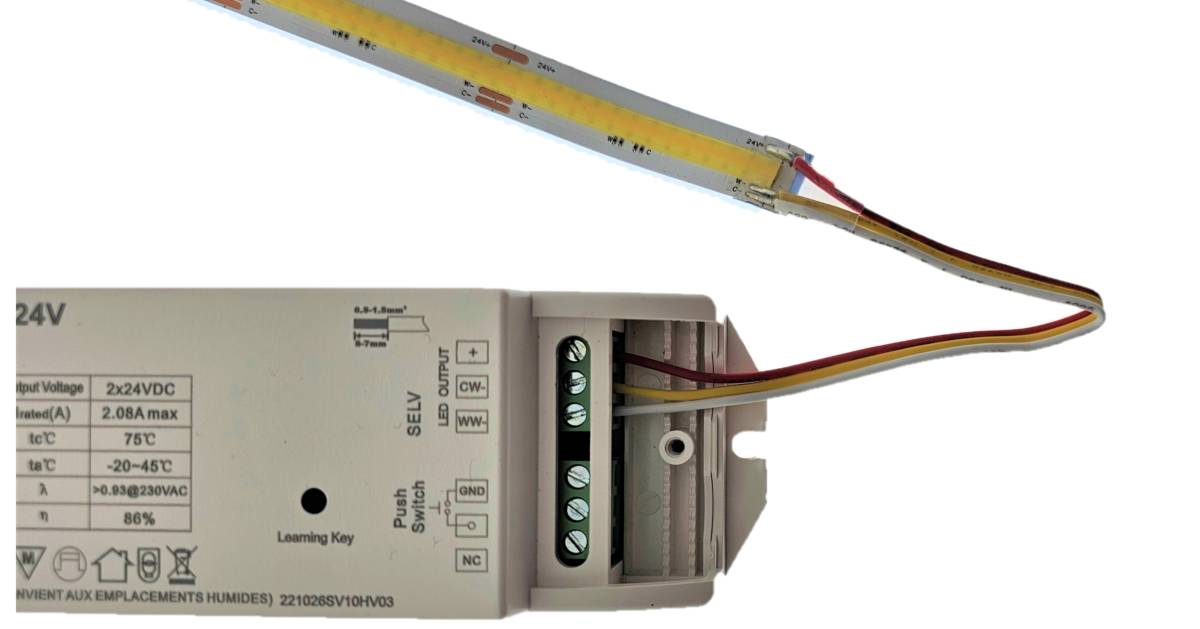 In the image, a CCT LED strip light is shown, with the wiring identical to that of CCT spotlights or CCT panels.
If the color temperature only needs to be set once and no control devices are desired, a slide switch can be installed in between to select the desired tone.
In the image, a CCT LED strip light is shown, with the wiring identical to that of CCT spotlights or CCT panels.
If the color temperature only needs to be set once and no control devices are desired, a slide switch can be installed in between to select the desired tone.
 CCT slide switch for setting the color temperature during installation.