Zigbee is one of the most long-standing and well-proven wireless technologies in the smart home space. It is used in lights, sockets, motion sensors, and various other sensors-exactly the types of devices that need to operate reliably and with low power consumption.
This article explores where Zigbee stands today, what Zigbee 4.0 will bring (and why it matters), and concludes with an overview of the current state of Matter from a consumer perspective.
What is Zigbee and why is it popular in smart homes?
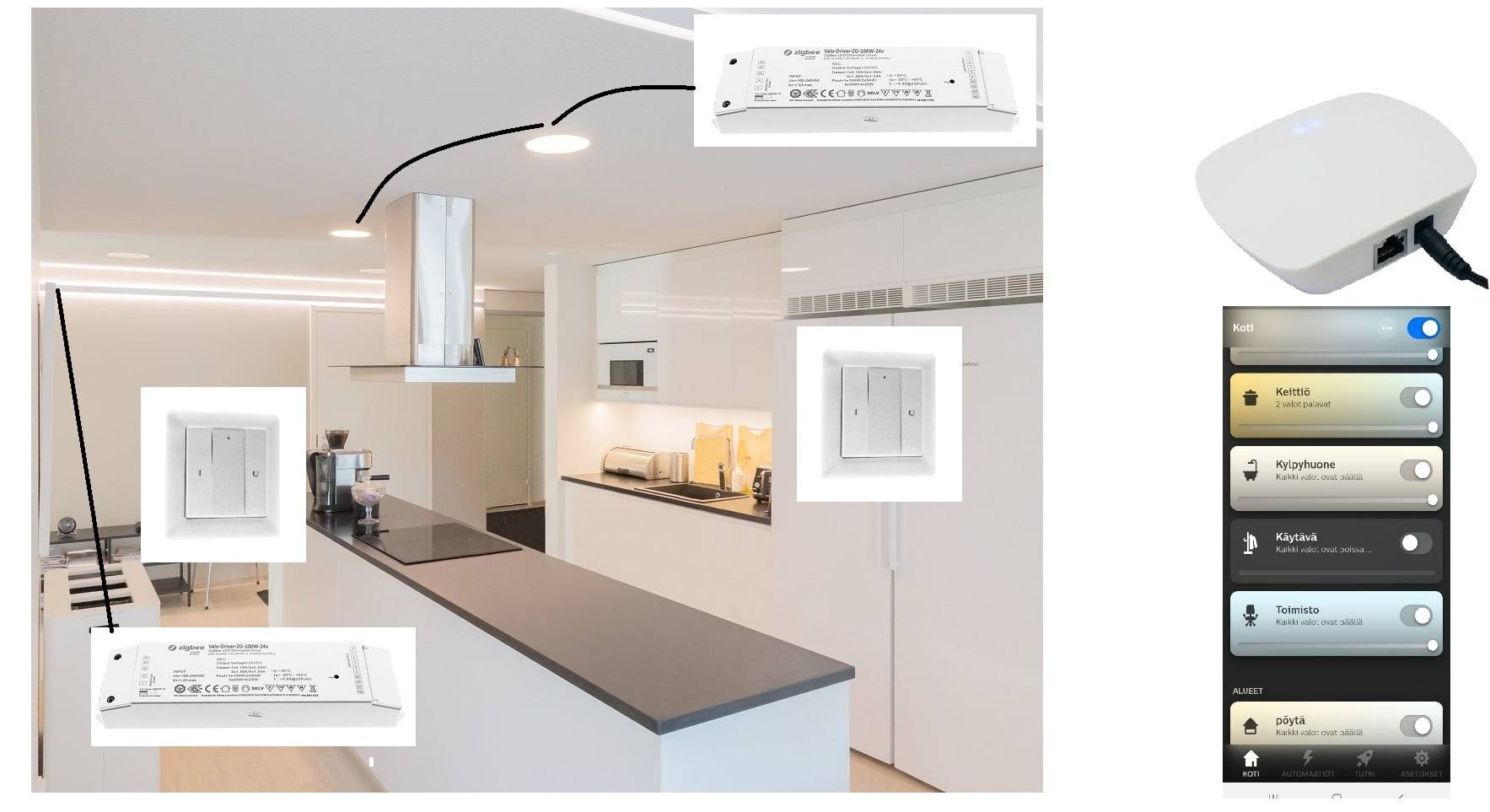
Zigbee is a low-power communication standard designed for device-to-device communication, particularly in smart home sensors and controllers. Its key strength is the mesh network: mains-powered devices (such as LED drivers, smart plugs, and smart bulbs) can relay messages forward, allowing the network to expand and improve coverage without requiring a direct connection between each device and the hub.
- Long battery life: sensors can operate for extended periods on a single battery.
- Mesh improves reliability: messages can take alternative routes.
- Wide range of devices: there is a large selection of Zigbee devices on the market across different price points.
In practice, a Zigbee network typically consists of:
- Coordinator (hub/gateway): manages the network
- Routers (mains-powered devices): 230V devices such as drivers, smart plugs, and relays
- End devices: typically battery-powered sensors
We have wrote more about Zigbee here.
Why Zigbee 4.0 is a significant update
The Connectivity Standards Alliance (CSA) released the Zigbee 4.0 standard in November 2025, marking a significant update to the popular smart home technology nearly ten years after Zigbee 3.0. The key improvements focus on extended range, enhanced security, and easier device commissioning. (For more information, see the CSA newsroom: CSA: Zigbee 4.0 and Suzi)
For many consumers, the most important promise is this: less hassle, easier setup, and an even more reliable network-even in challenging locations such as behind thick walls or in outbuildings.
Zigbee 4.0 - The most important changes and improvements
Suzi - Sub-GHz-support (better range)
The biggest innovation in Zigbee 4.0 is support for lower frequency bands (Sub-GHz), known as Suzi (Sub-GHz Zigbee).
- Frequencies: In Europe, the 800 MHz band is used, while in North America, the 900 MHz band is used.
- Benefit: lower frequencies typically penetrate walls and obstacles better than 2.4 GHz. This can allow devices (such as sensors and outdoor lights) to be placed farther from the hub or other routing devices in the network. The range increases from around 20-30 meters-> 40-60 meters and outdoors, the theoretical range can exceed 500 meters!
What does this mean at home? If you've struggled with the range of a shed sensor, garage door sensor, or outdoor lighting, Suzi is designed exactly for that: better coverage and fewer dead zones.
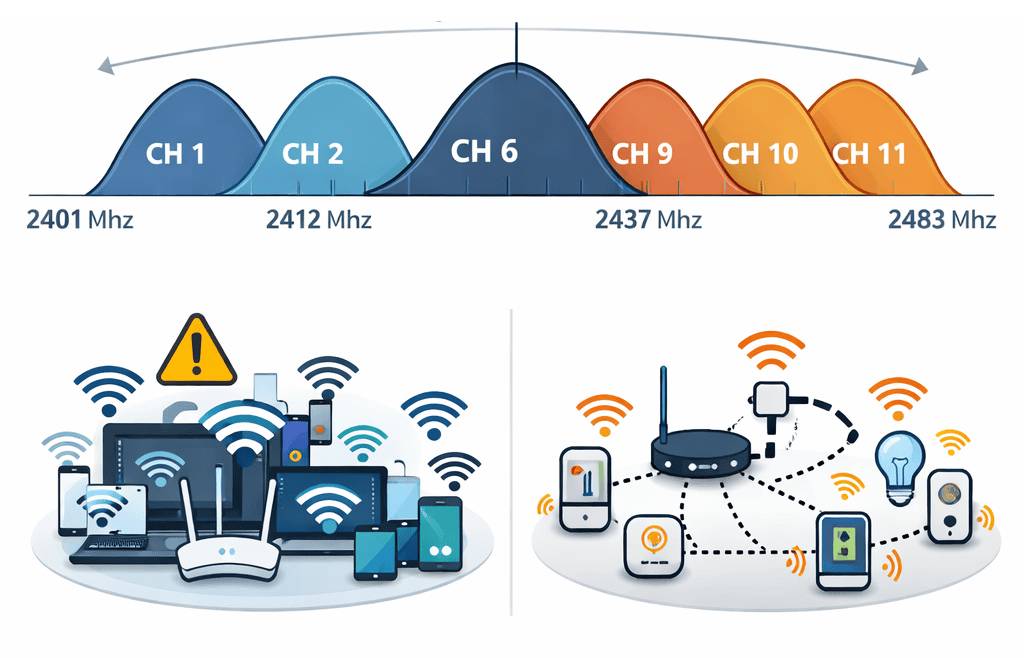
In addition, Zigbee 3.0 operates on the 2.4 GHz frequency band, which is the same range used by so-called legacy Wi-Fi. In environments where older Wi-Fi networks are still widely in use, this can lead to interference between Zigbee and Wi-Fi networks. Most modern Wi-Fi networks use the 5 GHz band, but many older devices-such as printers and IoT devices-still rely on 2.4 GHz. Fortunately, both Wi-Fi routers and Zigbee hubs allow you to select channels to help avoid interference.
Enhanced security
Zigbee 4.0 strengthens network security to meet modern requirements. The goal is to reduce the risk of misuse and improve pairing and key management.
- Secured Trust Center - "Restricted Mode": ensures that only an authorized central unit can modify device states.
- Dynamic Link Key: a new method for device pairing that enhances network key security.
- Improved protection against attacks: enhancements designed to prevent issues such as replay and rejoin-type attacks.
Why this is important for the consumer? A smart home is no longer just a network of hobbies. With locks, alarms and presence detection, security should be built-in and not an add-on.
Easier setup (onboarding)
LedStore devices have so far exceptionally supported the so-called Touchlink function, which allows Zigbee buttons and devices to be paired directly, without the Hub. So, in effect, the button and the device create their own network.
Adding Zigbee 4.0 devices to a network has been made more user-friendly, which is especially important when managing a large number of devices-and helps bring these improvements into the mainstream across more manufacturers.
- Zigbee Direct: enables devices to be paired and controlled directly with a smartphone via Bluetooth Low Energy (BLE), without necessarily requiring a dedicated hub from the start.
- Batch Commissioning: supports the simultaneous setup of multiple devices, speeding up smart home installations (and reducing the nerve-wracking "add device - wait - add device - wait" cycle).
Practical benefits: an easier start, smoother expansion, and fewer setup-related hurdles-especially when building or renovating and installing dozens of devices at once.
Improved performance and energy efficiency
Zigbee 4.0 also includes improvements aimed at making the network more stable and extending the battery life of devices.
- Battery life: improved "sleepy end device" behavior and Coordinated Sampled Listening (CSL) can extend the lifespan of battery-powered devices.
- Reliability: standardized message retry mechanisms reduce packet loss and improve overall network stability.
- Trust Center Swap-Out: allows the network's central hub to be replaced without needing to re-pair all devices.
A relief for the consumer: For many, replacing a hub has been a "don't touch if it works" situation. The swap-out idea brings Zigbee closer to what a smart home should feel like: maintenance should not bring down the whole home.
Backward compatibility
Zigbee 4.0 is backward compatible with Zigbee 3.0. This is good news for consumers: existing devices don't become obsolete just because the standard is updated.
When will Zigbee 4.0 devices be available?
- Sertification started at the end of the year 2025
- The first Zigbee 4.0 devices are likely to appear during 2026
What should you do now? If you're buying devices right now, the Zigbee 3.0 ecosystem is still highly practical and reliable. You can later expand and upgrade within the same ecosystem to Zigbee 4.0 / Suzi-compatible devices and hubs-especially if you need longer-range solutions.
Zigbee today: where it fits best in 2026
Zigbee excels particularly in the following use cases:
- Sensors: motion, door/window, temperature, humidity, and leak sensors
- Lighting and switches: reliable control and responsive performance
- Smart plugs and relays: routing and control in one package
- Local automation: in many systems, automations can run even without a cloud connection
Wi-Fi devices are often best suited for cameras and other data-heavy applications. Zigbee, on the other hand, is typically the better choice for "small but critical" communication that needs to be reliable and long-lasting.
Home automation systems like Tuya combine Wi-Fi and Zigbee into a single platform, allowing you to control devices using different protocols within the same system (with Tuya-compatible devices).
Note: Zigbee Alliance is now known as Connectivity Standards Alliance (CSA), and CSA is also in the background of Matter.
Matter and its current state from a consumer perspective
Matter is a smart home standard whose goal is to make it easier to use devices across different ecosystems (such as Apple Home, Google Home, and Amazon Alexa). When a device is Matter-compatible, it should in principle work more broadly without manufacturer-specific lock-ins.
Key point: Matter does not directly "replace" Zigbee, because they operate at different layers. Matter is a shared "language" and interaction model for ecosystems, while Zigbee is the actual radio technology/protocol that devices use to communicate. In the Matter ecosystem, the equivalent mesh radio technology is often Thread (as well as, in some cases, Wi-Fi/Ethernet).
Advantages of Matter for consumers in 2026
- Compatibility becomes easier: less guesswork about "will this work with my platform?"
- Local control: in many cases, devices can be controlled locally, not just through the cloud.
- Less ecosystem lock-in: switching from one platform to another can be easier than before.
The realities of Matter (the honest part)
- Not all features are fully standardized yet: "basic control" (on/off, dimming, sensors) often works well, but manufacturer-specific advanced features can still vary between platforms.
- Device support is growing, but varies: the range of devices has expanded quickly, but not all product categories are equally mature yet. At this pace, things should start to look more complete by late 2026 or 2027.
- The role of bridges is emphasized: many existing Zigbee ecosystems integrate into Matter "through a bridge" (e.g., a Zigbee hub appears in Matter and brings Zigbee devices along with it).
What does this mean for a Zigbee buyer?
If you already have Zigbee devices (or plan to buy them), the good news is that Zigbee isn't going away overnight. On the contrary:
- There is a huge number of Zigbee devices on the market, and Zigbee 4.0 significantly improves the standard.
- Many manufacturers are bringing Zigbee devices into Matter via a bridge (hub/bridge), allowing you to make use of your existing devices within a Matter environment as well.
- If you're starting from scratch and want to maximize future compatibility, it's worth looking at Matter-over-Thread options in device categories where they are already mature-but Zigbee is a reliable choice both now and going forward.
You can find all Zigbee and Matter products in our online store.
Where are Zigbee 4.0 and Matter heading?
Zigbee looks quite strong both now and in the future. Zigbee 4.0 brings concrete improvements in the areas that benefit home users the most: range (Suzi / Sub-GHz), security, and easier setup.
At the same time, Matter continues to address the smart home compatibility problem ("works with this hub, but not with that one…"). From a consumer perspective in 2026, the most sensible approach is often a hybrid:
- Zigbee (and going forward Zigbee 4.0 / Suzi) for many sensors, lighting, and reliable core devices
- Matter as the "common language" between ecosystems, making integration easier
- Thread / Wi-Fi depending on the situation, especially for newer Matter devices and data-intensive devices
The result? The smart home is finally moving toward what it should have felt like from the start: less tinkering, more reliability. That said, Matter has been "just around the corner" since 2023.