
Lighting control systems, such as DALI dimming, have evolved considerably in recent years with the introduction of new technologies that allow greater accuracy and flexibility in lighting control. One of the most interesting of these technologies is DALI (Digital Addressable Lighting Interface), which allows sophisticated dimming control of individual lights or groups of lights. In this article we take a closer look at DALI dimming, its benefits and how it can improve the functionality and energy efficiency of a lighting system. This article is a continuation of the one where we went through dimming techniques
What is DALI dimming?
DALI dimming is a lighting control system that uses a digital protocol to communicate between the lighting controller and the lights themselves. This allows precise control of the brightness and colour of individual lights or groups of lights, as well as the storage and recall of pre-programmed lighting situations. DALI dimming systems typically consist of a DALI controller that sends commands and DALI-compatible lights that can receive and respond to these commands.
DALI works best when it is designed and built from the ground up. This is because two control wires are needed to run between the devices.
The DALI system spelled out in a nutshell
Suppose you have several lamps in your room and you want to adjust the brightness of all of them at once. This is where DALI comes in!
A DALI system is like a boss that tells all the bulbs what to do. It uses special signals, as if the boss were shouting orders to the lamps. These signals tell the bulbs how much electricity they should use and how bright they should be.
Each lamp or group of lamps has a special computer, called a DALI controller, which listens to signals from the DALI system. When the DALI system sends a signal to a lamp, the lamp's DALI controller receives the message and causes the lamp to brighten or dim accordingly.
So when you use a DALI dimmer switch, it sends a signal to the DALI system. The DALI system then sends signals to all the lights in the room, telling them how bright they need to be. This is how DALI works!
Key features of DALI
- It's a free protocol! Anyone can use it.
- DALI2 certification requires devices made by different companies to work together.
- DALI is fairly easy to set up. You can install the power and control cables side by side, as they do not need to be protected. So there are 5 wires running everywhere: L, N, ground and 2 control wires. (5x1.5 MMJ)
- The wiring can be installed in any way, as long as the wiring is within 100 metres of the DALI BUS controller. The distance can be even greater if repeaters are used.
- Because DALI uses digital signals for communication instead of analogue signals, the devices receive the same dimming values. In this way, the steering groups are very efficient and precise.
- The system's addressing system (DALI address) ensures that each device or group can be controlled individually.
Advantages of DALI dimming
Dimmable DALI is an efficient and flexible lighting control technology that offers many advantages over traditional analogue dimming systems. Its accuracy, energy efficiency, scalability and ability to integrate with other building automation systems make it well suited for a wide range of applications in commercial, industrial and residential buildings. Here are the benefits of DALI dimming:
- Accuracy: DALI dimming allows precise control of the brightness and colour of individual lights or groups of lights, which can be particularly useful in commercial, industrial and residential buildings. This allows for greater control and flexibility in lighting design.
- Energy efficiency:DALI dimming can help reduce energy consumption and lower running costs, as the brightness and colour of the lights can be precisely controlled.
- Scalability: DALI dimming systems can be easily extended to control a large number of lights, making them well suited for large commercial or industrial projects.
- Integration: DALI dimming systems can be easily integrated with other building automation systems, such as HVAC and security systems, allowing better control and automation of building lighting.
- Flexibility: DALI dimming allows a wide range of options for controlling lights, from simple on/off switching to more advanced control options such as setting and resetting pre-programmed lighting conditions.
- Open standard: it ensures that devices from different manufacturers always work in the same way when they are connected to each other. You can also replace existing parts with newer and better ones as they become available.
- Easy to install: with DALI fibre optic technology, you don't need to split lights into zones or keep track of wiring. Two wires are connected to the DALI system. These wires control all the devices. Installers don't have to keep track of everything, because they don't need to know how the lights will eventually be installed.
- Easy to change: you can make changes to the settings quickly. After a while, you might want to change the lights and get something nicer. Centralised software allows you to easily change lighting profiles.
Why should you NOT use DALI dimming?
However, like all technologies, DALI dimming has its pros and cons. Not everything is always as easy as advertised. Here are some of the downsides of DALI dimming:
- Cost: DALI dimming systems can be more expensive than traditional analogue dimming systems because they require DALI-compatible luminaires and a DALI controller.
- Installation: DALI dimming systems can be more complex to install than traditional analogue dimming systems and may require special training and expertise.
- May not be easy to replace: after a while you may want to change the lights and get something nicer. Depending on the size of the system, a software engineer may be needed for programming.
- Compatibility: not all luminaires are compatible with DALI dimming systems, because the range is narrower, for example in interior lighting.
- Limited availability: DALI dimming systems are not widely available.
- Keep up to date: For a DALI system to work, you need to create a database that links LED addresses to the right controllers. For these systems to work optimally, they need to be monitored.
- Not for retrofitting: it is best to leave DALI in new buildings, as it is very difficult to retrofit two extra cables.
DALI can therefore be more expensive and complex to install and requires specialist training and expertise. In addition, not all luminaires are compatible with DALI dimmer systems and may not be widely available from all retailers. Carefully consider your needs and budget before deciding whether a DALI system is right for you.
History of DALI
DALI has its roots in the late 1980s and early 1990s, when a group of lighting manufacturers, scientists and engineers came together to develop a standardised digital communication protocol for lighting control.
DALI (Digital Addressable Lighting Interface) dimming is a relatively new technology in the field of lighting control systems, but its development history goes back several decades. It was started by European ballast manufacturers. The idea was to make a better version of the 0/1-10V dimming, by letting the control system signal each LED driver and group of devices in both directions. 0-10V controls allow communication in one direction only.

DALI 1.0
In 1998, the International Electrotechnical Commission (IEC) published the first version of the DALI standard, known as DALI 1.0. This standard defined the protocols and electrical characteristics of DALI systems, enabling the development of interoperable products between different manufacturers.
In the following years, the DALI standard was updated and refined to include new features such as support for multiple control devices, improved security and greater scalability. In 2012, the IEC published the latest version of the DALI1 standard, known as IEC 62386, which is now widely used in the lighting industry.
Since the first DALI standard was published, the technology has grown rapidly in popularity and is now widely used in commercial and public spaces. DALI dimming is particularly popular in energy-efficient buildings, where precise control of lighting levels can help reduce energy consumption and costs.
DALI 2.0
DALI2 (2020) is the latest version of the DALI protocol, which builds on and improves the original DALI protocol.
One of the main differences between DALI and DALI2 is the number of devices that can be connected to one system. The original DALI protocol allows up to 64 devices, while the DALI2 protocol allows up to 512 devices. This means that DALI2 can control a larger number of lights and other devices in a single system.
The second difference is functionality. DALI2 offers additional features such as lighting scenes, CCT lighting and RGB lighting. DALI2 also provides better support for sensors and other devices, enabling more advanced control and automation.
In terms of security, DALI2 also offers enhanced security features such as secure firmware updates, secure key exchange and communication encryption. This makes DALI2 more resistant to hacking and other security threats.
Overall, DALI2 is an improvement over the original DALI protocol, offering more advanced features, greater scalability and improved safety. It is also backwards compatible with DALI, so devices using the original DALI protocol can still be used in a DALI2 system.
What are the main differences between DT6 and DT8?
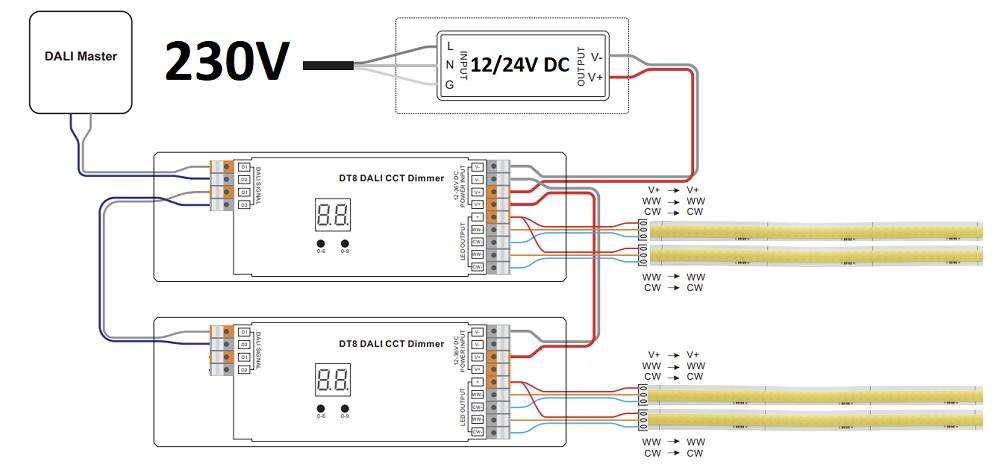
The DT6-led driver needs one DALI address to adjust the brightness of one colour of the LEDs.
The DT8 commands and features are intended for colour control only, but the DT6 functions can be used with any DALI LED driver.
You can use part 207, part 209 or both for a colour-changing LED driver.
One DALI address can control any number of DT8 LED controllers. This allows both the colour temperature and brightness of the light to be controlled from a single address. DT6 would need separate addresses for each colour.
The most commonly used DT numbers are:
DT6 LED controllers Part 207
DT8 colour control devices Part 209
Compatibility between products
The first version of DALI did not work well with other systems. It didn't work because the protocol was too narrow and many different companies tried to improve it by adding features that didn't work well together.
With DALI2, this problem was solved. DALI2 is much more comprehensive and has many more features than its predecessor. This means that certain manufacturers can no longer make changes to DALIii and all DALI2 devices must meet all IEC62386 standards.
Remember that although DALI2 also allows you to use older DALI components, you cannot do everything you can do with DALI2 because older DALI devices have limited commands.
How is a DALI device controlled?
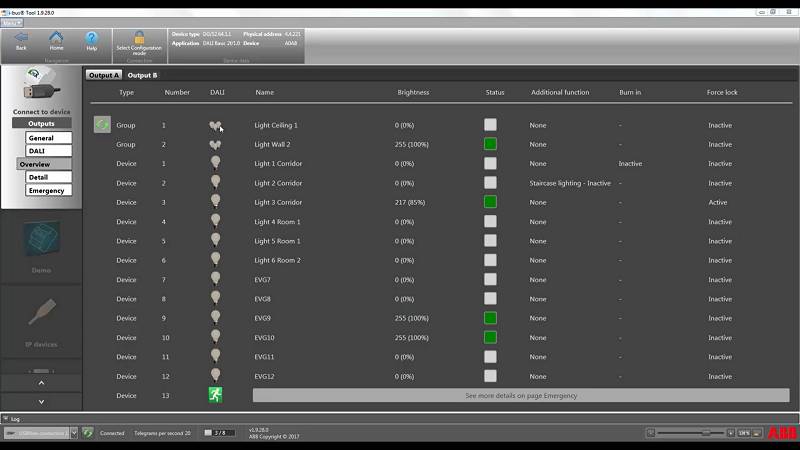
DALI installations use standard LED lights. They use DALI receiver modules and DALI transformers. These components are connected by DALI bi-directional digital communication lines. The control centre can be anything from a laptop to a high-tech lighting control desk.
By focusing and adjusting the push-button commands, you can control a single light, a group of luminaires or a lighting zone. When a switch is used, you can program all lights in the same 'group' to turn on or change colour at the same time.
What are the components of DALI?
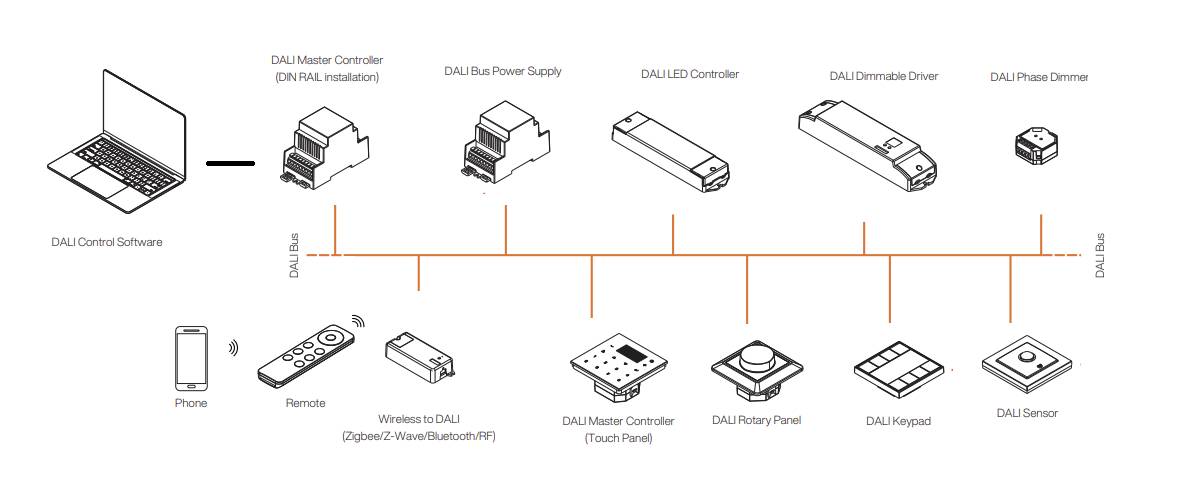
DALI (Digital Addressable Lighting Interface) dimming is a type of lighting control system that allows precise control of the intensity of individual lights or groups of lights. The system consists of several key components, including:
DALI-master: these devices act as the hub of the system and are responsible for sending commands to the lights. They are usually linked to an interface, such as a wall-mounted touchscreen panel or a smartphone app, that allows users to adjust lighting levels.
DALI transformers or controllers: these devices are responsible for controlling the power to the lights, and are usually installed in the luminaires themselves. They receive commands from the DALI controller and adjust the light output, light colour or light colour temperature accordingly. e.g. DALI dimmer.
DALI sensors: these devices are used to measure the ambient lighting level in a room and can be used to automatically adjust lighting levels for optimal visibility and energy efficiency. They can be integrated into a DALI controller or installed as separate devices.
DALI power supply: a DALI power supply is a device that supplies power to a DALI system. It is a separate component that connects to the DALI controller and the lights.
DALI communication cables: these pairs of cables connect the different components of a DALI system.
What is a DALI bus (DALI BUS)?
In a DALI system, ALL devices and the bus power supply are connected to a two-wire bus and share information. This 2-wire system is the nervous system of the lighting system. It sends and receives all signals from the controller to the lamps and back. So you always know the status of your device from the device driver or software.
The DALI bus must be powered to send data between devices. It uses about 16V. These devices are called DALI power supplies or in many cases the DALI master also acts as a power supply for the signal cables.
How are DALI lighting systems wired?
As mentioned earlier, you can send digital signals over the bus with only two wires. Cables can be either positively or negatively polarised. Most control devices work on both. DALI systems can be wired using standard five-wire cabling, so no special protection is required.
Since no wiring groups are required in a DALI system, you can connect all the wires in parallel with the bus. This is a significant change from traditional lighting systems, as the commands sent from the controller contain all the information needed to switch on, dim and change the colour of the lights.
Once everything is connected, the Dali software can be set up to work with the system. Because the system is flexible, you can build and use different lighting scenarios and programs without changing the physical wiring. Depending on the software and applications, this setting can be easy or difficult.
Where are DALI lighting systems used?
DALI is a lighting technology that can be modified and is reasonably priced. This type of centralised lighting system is most often found in large commercial premises (e.g. night and day lighting can be programmed separately). DALI is mainly used in companies and large installations. However, people are increasingly using it in their most prestigious homes. At home for example for dimming a led tape or if you want led panels and indirect light for a certain stored space.
DALI, TRIAC or PUSHDIM?
A triac dimmer will therefore only work with two wires, whereas a DALI dimmer requires at least 4 wires. PUSHDIM can often also be implemented with only two wires.
The Dali2 system allows CCT led lights to be controlled and dimmed, but Triac only allows dimming, as does PUSHDIM.
So downlights, led strip, led panel. All light sources are suitable for all types of dimming, but the driver you choose for the led light determines how it is controlled.
Summary
DALI dimming is an efficient and flexible lighting control technology that offers many advantages over traditional analogue dimming systems. However, it can be more expensive and complex to install and deploy, and requires special training and expertise. In addition, not all luminaires are compatible with DALI dimming systems and they may not be widely available in all countries and regions. Carefully consider your needs and budget before deciding whether DALI dimming is right for you.
https://www.youtube.com/embed/69Kxt8t2S30
Frequently asked questions about DALI
1. Miksi DALI himmennys?
DALI can help designers, building owners and electricians to control lighting. DALI is a standard, so you can be sure that it will work with different lighting companies. You only need two wires from one device to another, in addition to electricity.
2. Mitä on DALI himmennys?
DALI stands for "Digital Addressable Lighting Interface". DALI dimming is a lighting control technology that allows precise control of the brightness and colour of individual lights or groups of lights. It uses digital communication instead of analogue signals to control lights.
3. Mitkä ovat DALI-himmennyksen edut?
DALI dimming offers many advantages over traditional analogue dimming systems, such as accuracy, energy efficiency, scalability and easy integration with other building automation systems. It also allows a wide range of options for controlling lights, from simple on/off switching to more advanced control options, such as the control of pre-programmed lighting situations.
4. Mitkä ovat DALI-himmennyksen haitat?
DALI dimming systems can be more expensive than traditional analogue dimming systems because they require DALI-compatible luminaires and a DALI controller. They can also be more complex to install and deploy, and may require specific training and expertise. In addition, not all luminaires are compatible with DALI dimming systems, and they may not be widely available everywhere.
5. Onko DALI himmennys yhteensopiva nykyisten valojeni kanssa?
Not all luminaires are compatible with DALI dimming systems, so you may need to replace existing luminaires to use DALI dimming. It is important to check the compatibility of existing lights with the DALI dimming system before making a decision.
6. Voinko ohjata DALI himmennystä etänä?
Yes, DALI dimming systems can be easily integrated with other building automation systems, such as HVAC and security systems, allowing better control and automation of building lighting, including remote control.
7. Miten DALI himmennys säästää energiaa?
DALI dimming can help reduce energy consumption and lower running costs by allowing precise control of the brightness and colour of lights. This can lead to lower energy consumption and cost savings.
8. Tarvitsenko erityistä koulutusta DALI-himmennyksen käyttöön?
DALI dimming systems can be more complex to install and commission than traditional analogue dimming systems, and may require specific training and expertise. It may be necessary to hire a professional to install and program the DALI dimming system, but it is usually easy to use it yourself.
9. Onko DALI himmennysjärjestelmä laajalti saatavilla?
DALI dimming systems are not widely available from all vendors. It is important to check the availability of DALI dimming systems in your area before making a decision and to ensure that support will continue to work after purchase.
10. Mikä on DALI-vastaanotin?
DALI receivers give you control over your LED lights. You need a receiver for your light to make it a DALI light. The light connected to the receiver can then be controlled by DALI, allowing you to adjust the brightness or colour temperature of the light, for example.
We are familiar with the control technology of Led lighting
LedStore has been an expert in LED lighting and lighting design since 2010. We have our own product design, so our products are technologically state-of-the-art. Products have quarantee for up to 7 years. We also carry out lighting maintenance.
We focus on temperature-controlled and high colour rendering lights, so they work brilliantly and last a long time. We do around 500 lighting designs for our clients' sites. Read more here or order a lighting design
We offer a service of custom-made led strips, i.e. custom-made led strips in aluminium profile. Also installed. Did you know? LedStore offers lighting design from 169 euros for the whole house!
Remember that we are always ready to offer our help to you along the way, by email (myynti@ledstore.fi) and by phone (045 251 4510). You can always feel free to share photos of your own projects on social media on #ledstore.fi IG and ledstorefinland FB. We love to see the cool things done by our LEDs, and it also helps to provide inspiration for those who are not sure about the power and awesomeness of LEDs. Did you know that we already have over 3500 pictures of our LED installations in our Gallery!
Photo gallery of Led lights:
Product gallery: Pictures of PRODUCTS in different installation locations
Indirect light: Indirect light in different spaces
Room-specific: Light in different rooms
References: Complete houses that have been photographed