The beam angle—how widely a light fixture spreads its light—is a key factor in home lighting. A narrow beam focuses light precisely, while a wide beam distributes it across a larger area. This influences both the room’s atmosphere and its perceived brightness, as measured in lux.
Many consumers focus only on lumen output, but the real user experience depends more on where and how the light lands. In this article, we explain how beam angle affects lighting in practice—complete with measurement results from LED spotlights and panels.
What does beam angle mean?
Beam angle refers to how widely the light beam spreads from a fixture. The larger the angle, the more broadly the light spreads—and the smaller the angle, the more precisely the light is focused.
A flashlight for example: with low power and a narrow beam, it lights up a small area precisely, while with a wide beam you could see an entire section of the room. This detail has a significant impact on how a space looks and feels.
Comparison of different beam angles: narrow vs. wide
| Opening angle | Beam width | Fits especially |
| Under 30° | Precise spotlight | Paintings, accent lighting |
| 30°-60° | Semi-narrow light | Kitchens, bedrooms |
| 60°–90° | Normally decentralised | Sitting room, hallway |
| Over 90° | Wide general lighting | Ceiling lights |
How is the effect of the angle of incidence of light reflected in the lighting ?
The link between atmosphere and purpose
Different rooms need different lighting.
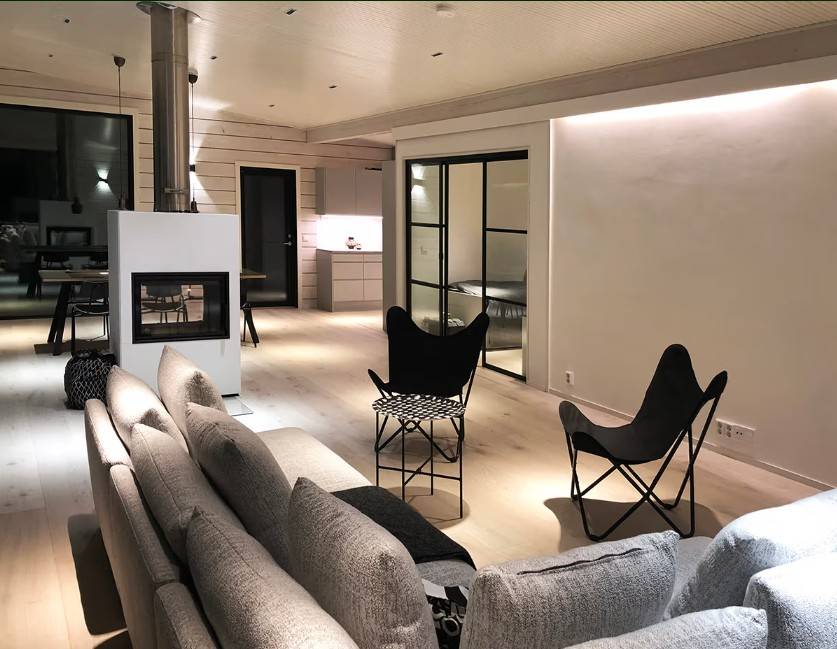
- In a living room, you want atmosphere and soft light - this is how a quality general light with a wide angle works.
- In the kitchen, you need accurate working light - a smaller angle helps you see without glare.
- In the bathroom, precise lighting around the mirror is ideal, but the rest of the space can benefit from a wide beam.
Differences in light angles
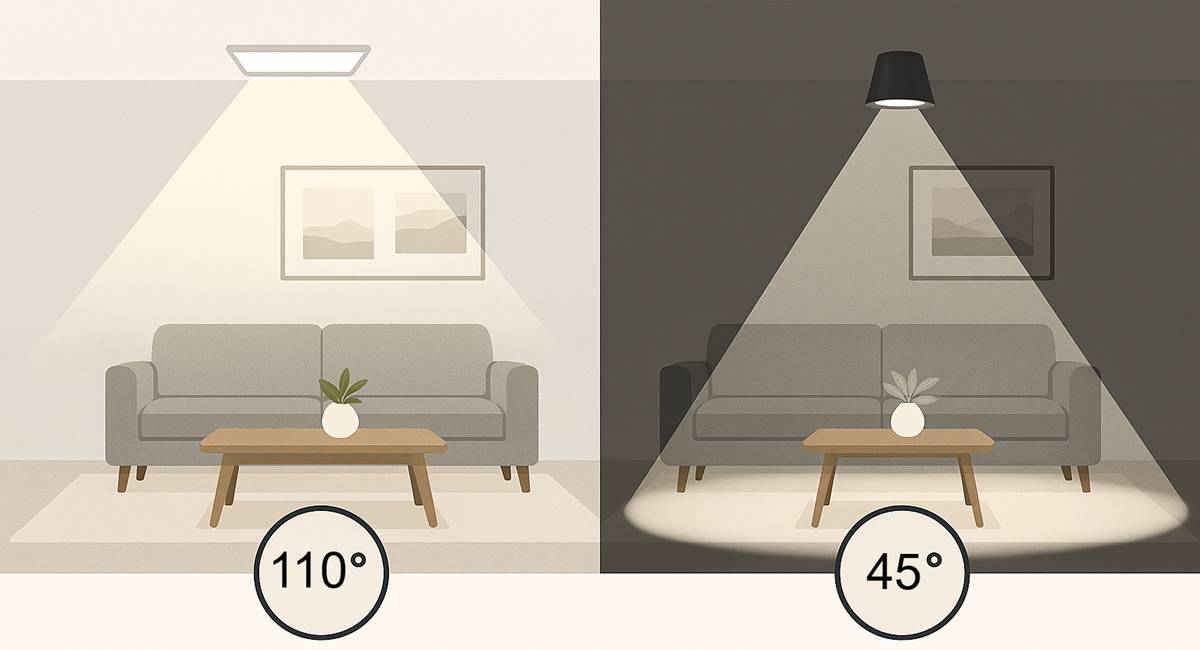
Narrow angles: precise target illumination
Benefits:
- Precise lighting
- Less side hustle
- Suitable for highlighting
Disadvantages:
- Not suitable for general lighting
- Needs several lights
Wide angles: best general lighting
Benefits:
- Soft and even lighting
- A natural experience for interior design
Disadvantages:
- Dull or unresponsive - Not necessarily interesting
- Not sufficient for illuminating a single object
Opening angle and energy efficiency
The right opening angle reduces wasted light and unnecessary electricity consumption.
- Wide angle in a small space = risk of wasted light (out of the window)
- Narrow angle in a wide space = more lights needed to provide uniform light
In other words, even to avoid wasted energy, the right opening angles contribute to efficient lighting. Of course, remember that if the space is small and windowless, the reflection from a wide beam light through the walls will help to make the space more evenly lit. Keep in mind that the wall materials affect the reflection of light.
Adjustable light opening angle?
Choose the angle of the light according to the mode. Ideally, use LED lights with adjustable angles.
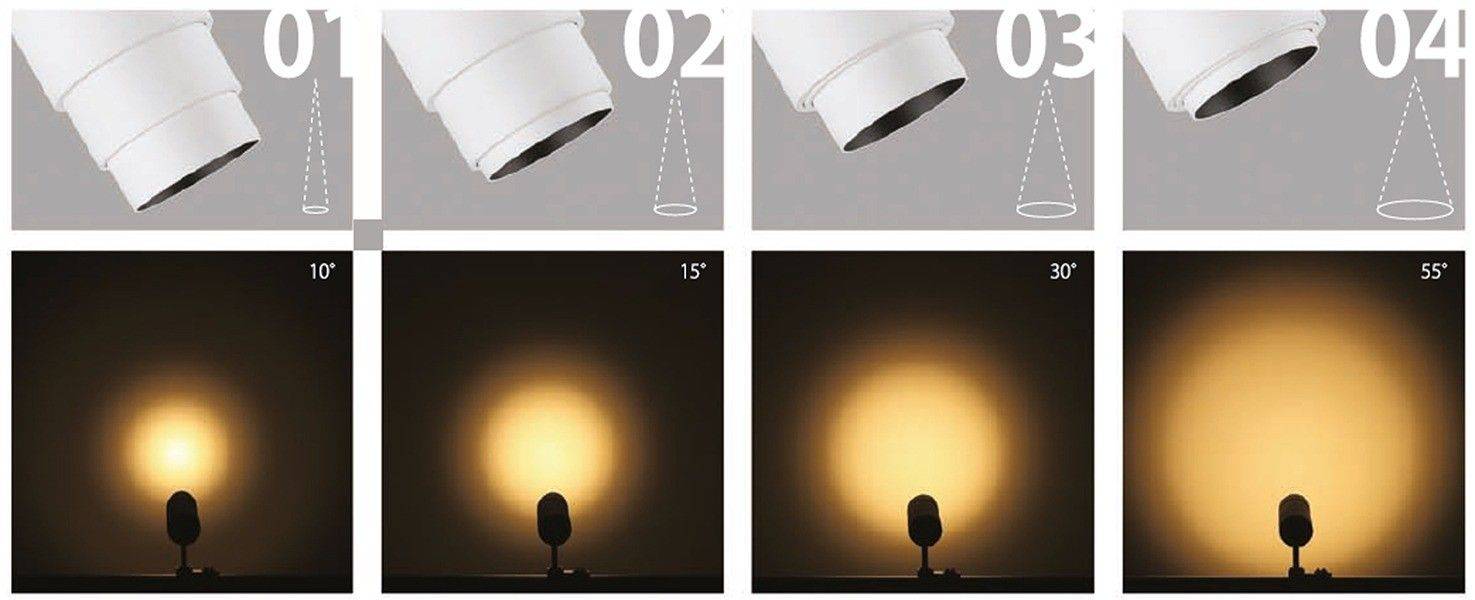
Focus product family
There are few adjustable lights, but the LedStore Fokus range, for example, allows you to freely choose the angle of light from 10 to 60 degrees. The range includes:
- Fokus 15 and 30W 3-phase rail light
- Fokus pendant light (plant light) 30W
- Fokus surface wall/ceiling light 2 x 7W
- Fokus recessed 7W
Adaptive Atmosphere 9W product family
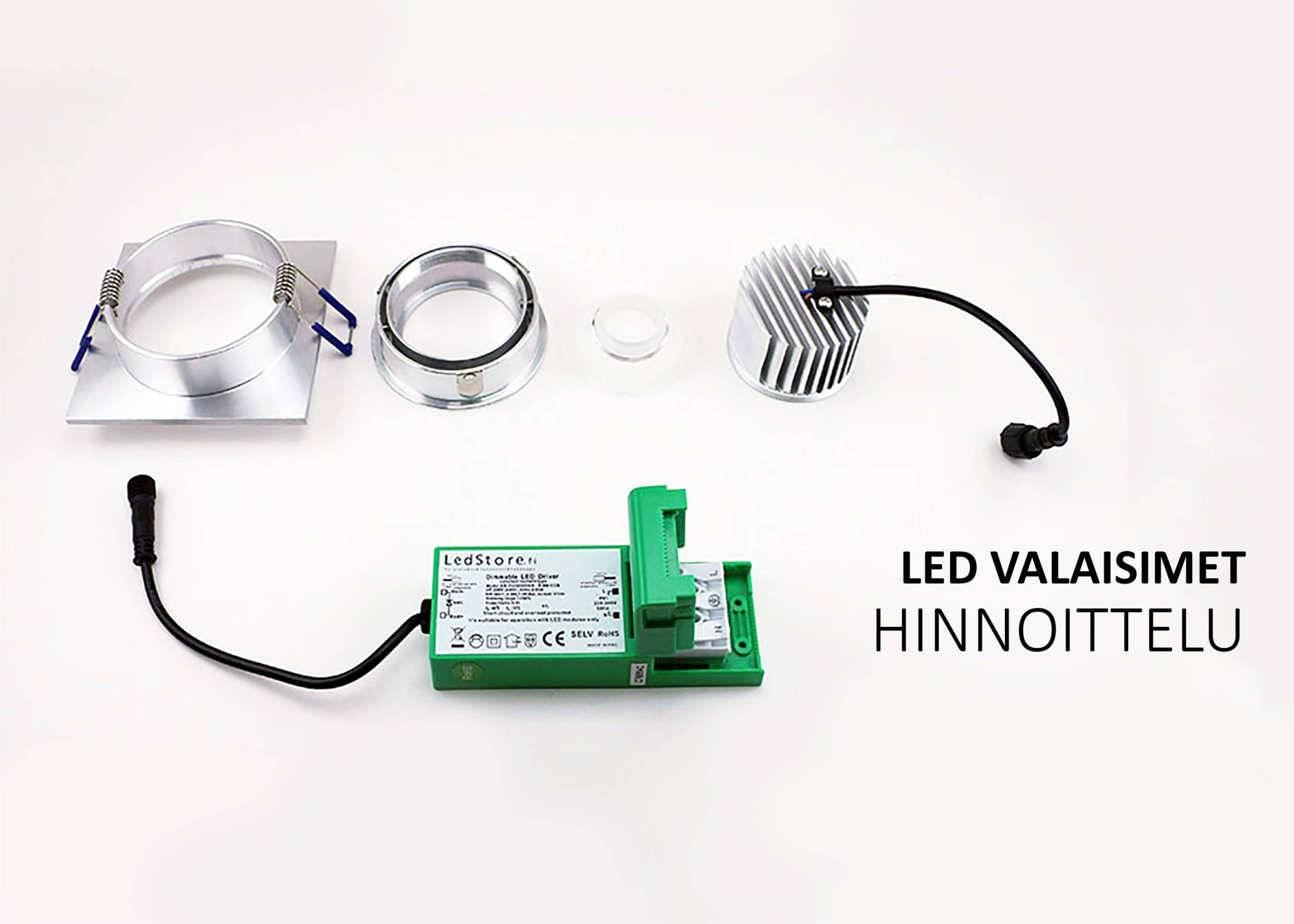
The 9W spots have a double lens in many models. The amount of light and the angle of aperture of the opal diffuser change. Removing the lens in 9W lights typically has the effect of increasing the amount of light by about 10-15%, and at the same time it changes the 60-90 degree general beam to a narrower 40-45 degree beam.
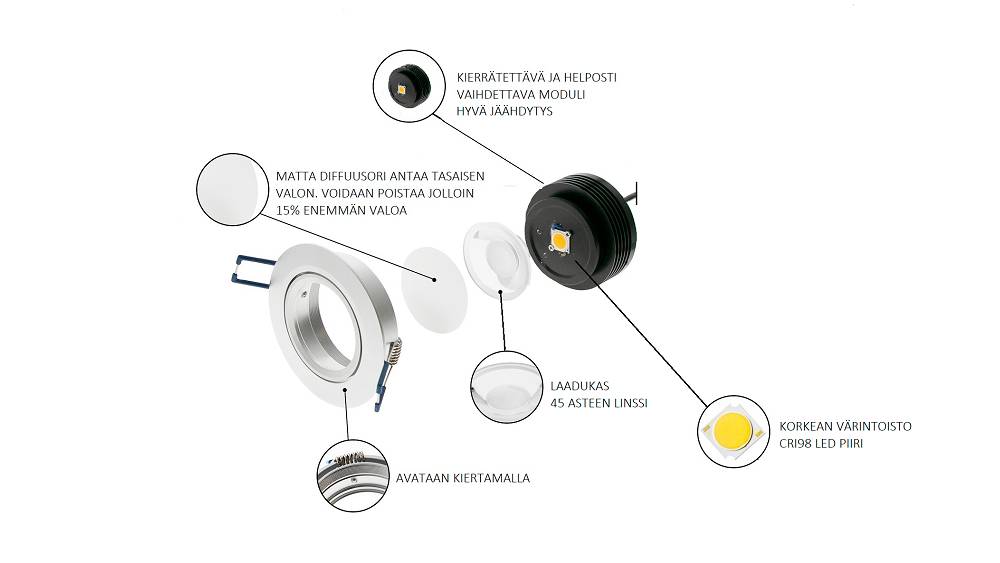
Light models where the lens can be removed and the angle of the light can be influenced:
| Model | Corner with opal | Corner without opal |
| 033 | 100 | 60 |
| R033 | 110 | 60 |
| SQ033 | 110 | 60 |
| SQ233 | 110 | 60 |
| R023 | 110 | 45 |
| SQ023 | 110 | 45 |
| SQ223 | 110 | 45 |
What is lux ?
Lux (lx) is a unit of measurement that tells you how much light falls on a given area. It combines the amount of light (lumens) produced by a lamp with how the light is distributed in a room. In other words: lux measures the brightness that the eye can actually see in a given place.
Lux formula
Lux = Lumen / m²
For example, if a lamp of 1000 lumens illuminates an area of 10 m², an illuminance is produced:
1000 lm / 10 m² = 100 lx
Illustrative examples from everyday life:
- Completely dark room: 0 lx
- Candlelight on table: about 10 lx
- General lighting in the living room of a home: 100-200 lx
- Kitchen worktop well lit: 300-500 lx
- Office workstation or precise crafting: 500-750 lx minimum
- Sunny midday outside: 100 000+ lx
Why should lux be understood?
Many people choose a light based on lumen output alone. But if the beam is wide, the light is spread over a large area - and the lux value is significantly reduced.
For example:
- LED panel, 120° opening angle, 1000 lm
→ provides light for a large area, but may only reach the worktop with 50 lx - Spotlight, 30° beam, 600 lm
→ concentrates light in a small area, allowing 150 lx or more on the worktop
Thus lux reflects the actual effect of the light at the exact point where the light is needed - be it on the floor, on a worktop or in a reading area. When designing lighting plans, we know the products and always know the right lights and quantities for the application.
How does lux change at different distances?
The lux value does not remain constant - it decreases rapidly as the distance to the light increases. This is because light spreads over a wider area as the distance increases.
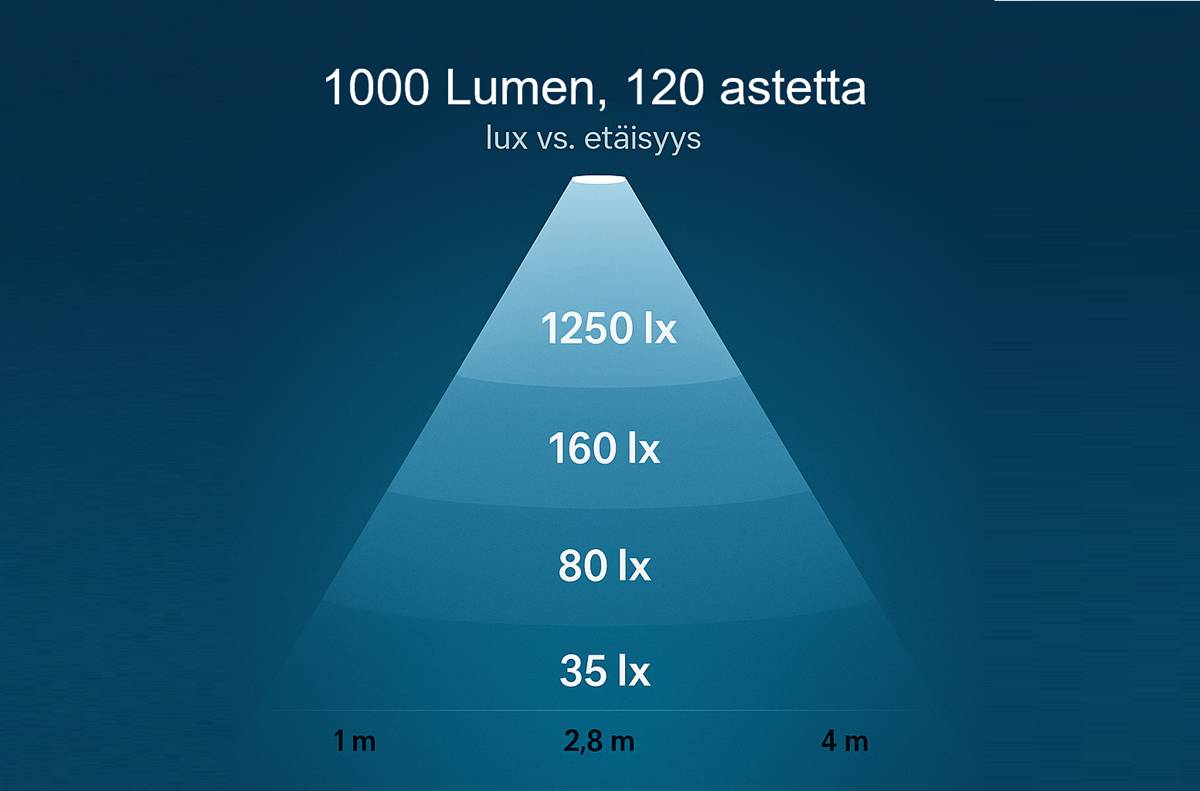
The intensity of light decreases inversely by the square of the distance, Inverse square law:
Lux ∝ 1 / distance²
This means that if the distance to the light doubles, the lux value drops to a quarter.
Room height and opening angle
In a high room (4-6 m):
- You need more powerful lights or more pieces
- Narrow beam helps focus light down more effectively
Low space (2.5-2.8 m):
- The wide wedge works well as a general light
- Ensure that light is not unnecessarily diffused on walls or ceilings if lighting is needed, for example on a worktop
Amount of light on the floor
Lux value on the floor
So, let's still try to figure out how the angle of the opening of the light affects the numbers on the floor. The height of a typical room is 2.5-3 m, which affects the number of holes in the floor.
- 1000 lm, 120° angle, from 2.8 m ≈ 50-100 lx
- 600 lm, 30° spot, same height ≈ 120-150 lx centre
In practice, this means that a lower output light with a narrower opening angle will reach the floor better than a higher output light with a wider opening angle. But you can clearly see where the light starts
Practical examples with a 1000 lm light (120° opening angle):
| Distance (m) | Illuminated Area (m2) | Lux |
| 1,0 m | 0,8 m2 | 1250 lx |
| 2,0 m | 3,1 m2 | 320 lx |
| 2,8 m | 6,14 m2 | 160 lx |
| 4,0 m | 12,6 m2 | 80 lx |
| 6,0 m | 28,3 m2 | 35 lx |
Note! The actual reading will vary depending on the type of luminaire, the shape of the beam and the environment.
Practical tips for lighting design
Here are some opening angles and general recommendations for different rooms. Of course, these are only our recommendations, and every interior will have an impact on the desired result.
Recommended opening angles per room
| Room | Recommended angle | Type of light |
| Living room | 60°-120° | Ceiling light, wall light |
| Kitchen | 30°-60° | Spotlight, spotlight |
| Bedroom | 60°-110° | Reading light, ceiling light |
| Bathroom | 30°-60° | Mirror light, roof light |
| Lobby | >90° | General lighting |
Errors to avoid
- Too many narrow-angled lights in the living room
- Broad light directly on the workstation = glare
- Incorrect light height causes unevenness
- Too narrow a light at the make-up point and you have to "go for the light"
A feeling from the horizon
The human eye experiences the illumination from a height of 1.6-1.8 m. This experience is shaped by:
- Flatness, without shadows
- Anti-dazzle
- Colour temperature and colour rendering (CRI > 90)
- Brightness without glare
The final assessment is based on the user's experience - metrics help, but it's the feeling that counts.
Tables of measured lights
Spotlights (1 m distance)
| Light | Power (W) | Lumen | Lux @1 m | Angle (°) | Attention |
| Piilo Round | 13,0W | 796 | 4539 | 23 | Very narrow, very bright |
| R023 | 9,1W | 645 | 262 | 110 | Wide and flat |
| SQ023 | 9,1W | 719 | 265 | 110 | General lighting |
| SLIM Spot | 120W | 1028 | 4671 | 20 | Super head, powerful range |
Panels and ceilings
| Light | Power (W) | Lumen | Lux @1 m | Angle (°) | Attention |
| Panel 300x300 | 15,6W | 1621 | 431 | 131 | Very wide and flat |
| Panel 200x200 | 15,8W | 1351 | 431 | 127 | General lighting |
| Panel 120x120 | 6,5W | 495 | 161 | 124 | Smaller, yet large |
| Ceiling 160 | 9,6W | 945 | 289 | 129 | General luminaire |
When to choose a narrow beam?
- To highlight paintings, shelves, interior details
- To illuminate a dining table or reading area
- For high spaces
When is a wide spotlight best?
- For general lighting in the living room, kitchen or bathroom
- For mood lighting where a glare-free and even brightness is desired
- For large spaces where a soft distribution of light is desired
Summary - choose wisely, light correctly
The angle at which the light opens is as important as the lumen or wattage figures. Even a small technical choice can change the lighting experience:
- Narrow angle = bright, precise light
- Wide angle = smooth, soft general illumination
Measure the needs of your space, combine different angles in different rooms and make sure that the lighting supports the intended use - whether it's to set the mood of your home or to make it more practical.
Frequently asked questions
- What is the best opening angle for your living room?
Over 90° for general light, 30°-60° for reading lights. - Can I change the angle afterwards?
Often not - unless an adjustable LED light is used. - Does the angle affect the brightness of the lamp?
Yes - a wide wedge can look dimmer despite the same bone structure. - Is one type of corner sufficient for the whole home?
No - different rooms require different angles depending on the intended use. - Is wide light always better?
No - too wide can make a room feel flat and shady. - How do I know the angle of the packaging?
Look for an entry like "Beam Angle: 60°"