What does the colour rendering index (CRI) mean?
Colour Rendering Index, CRI, a combination of letters that comes from the English words colour rendering index.
The colour rendering index tells us how well an LED light reproduces colours as they really are. The CRI is expressed as a number on a scale from zero to 100, where 0 = no colour reproduction and 100 = full colour reproduction.
Sometimes the scale is also seen in the negative direction, where light can even reduce a particular hue in the environment. For LED lights , the colour rendering index is also expressed in terms of Ra, which is measured on a smaller scale than CRI. The CRI of a light is the average of fifteen different shade values, while the Ra index is the average of eight different shade values. The Ra index does not include shades of red, for example, or skin tones, so the value is a glossed over figure for the actual quality of the LED. The most difficult colour for an LED chip to reproduce is red (R=9).
Ra index = R1-R8 (blue-green colours)
CRI index = R1-R15 (all colours)
So be careful, as Ra 90 can be CRI 70, as natural and red tones are not included in the Ra index measurement range. In other words, the Ra index does not measure the most challenging shades for LEDs.
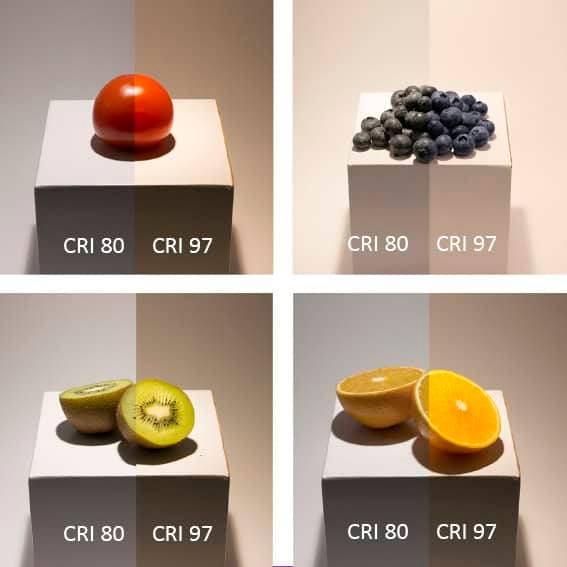
What is a good colour rendering index?
The ultimate breakthrough of LED lights has been hampered by its poor ability to produce the colours of the illuminated object naturally, according to critics. This manifests itself as a bluish light or a grey haze. You often hear people talking about pale people and hospital operating theatres.
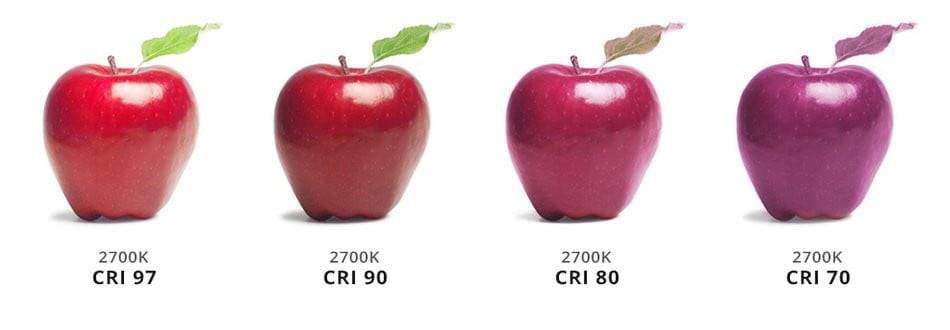
High quality LED lights also have a high colour rendering index, or CRI. Lights with a CRI above 90 are considered to have good colour rendering performance for domestic use. Such a light reproduces the colours of the interior in a natural way, without distorting the shades in a strange way.
Lights with a colour rendering index above 85 are generally perceived as quite natural. Light below CRI 80 is perceived as unnatural or coloured, and some objects may appear strange in the light. Red covers can even look like orange in poor light.
The weakness of low-cost LED lights is still their poor colour rendering (CRI 60-80).
In our view, lighting either spoils or enhances the beauty of a home. Lighting is one of the most visible parts of our homes, because it sets the mood for everything else in the interior. Poor light quality can ruin the look of carefully chosen wallpaper and paint tones.
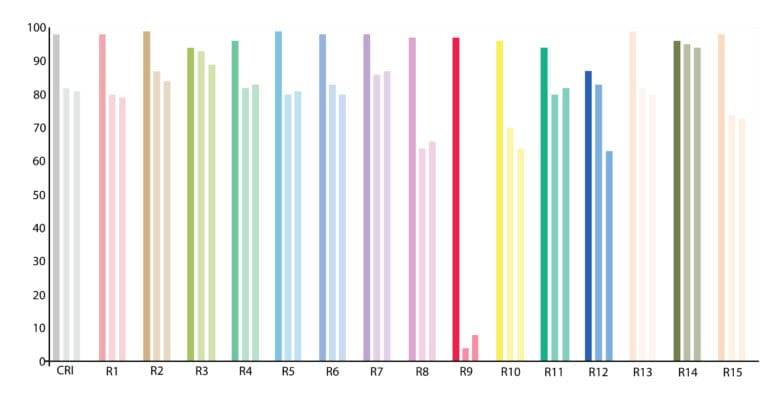
Why is the colour rendering index important information for LED lights?
In earlier light sources, the colour rendering index was not so important, as light sources such as incandescent and halogen always had a high level of colour rendering index in mind. In incandescent lamps, the colour rendering index of light is close to CRI 100. For this reason, the colour rendering debate did not play a significant role in home lighting.
However, most people also remember a product with poor colour rendering, fluorescent tubes, which were mostly only Ra 80, except for special tubes made for printing houses (even these were mostly only Ra 90). On fluorescent tube labels, for example, shade 830 meant Ra 80 (first digit) and shade 3000 K (next two digits). Most people remember the slightly greenish tint due to the poor colour rendering of fluorescent tubes.
LED technology has brought energy savings and other benefits, but the colour rendering index is still worth paying attention to.
Colour rendering index vs. colour temperature of light
The colour rendering index indicates how well the light reproduces the colours of, for example, the interior. The colour temperature of the light indicates the colour of the white light produced by the light.
The colour temperature is expressed in Kelvin. A traditional incandescent light bulb is typically 2 700K (yellowish), office lighting 4 000K (neutral white), outdoors in Finland around 5 500K (bluish). The colour temperature does affect the repetition of shades, with warm shades bringing out warm tones and cold shades bringing out cold ones.
Why invest in good colour rendering in light?
Good colour reproduction means a lot. It's important to see the right shades when putting on make-up or cooking, or to distinguish what colour clothes or furniture really are. If you've taken the time and effort to choose the shades of your interior, your colour sense is worthwhile.
In low light, the human visual system cannot distinguish colours properly, and something seems wrong even when there is enough light. Poor colour rendition is a strain on the eyes.
In addition to home use, good colour reproduction is also worthwhile in studios, painting studios, video and photography studios and hairdressing salons. Practically all applications where it is important to see colour tones without distortion.
Most common CRI recommendations
- Art studio/painting hobby CRI over 90
- Light or video photography over 90
- Domestic use over 85
- Office over 80
- Storage facilities over 80
- Industry over 70
Measurement results for LedStore lights
LedStore invests in the quality of its LED circuits, both in terms of colour rendering and adjustability. In our range you will find many products with high light colour rendering, with CRI over 90. We update our products with photometric measurement results, so you can see the exact light characteristics of each product. You can find the results on each product page, in the attachments section!