In this article, we explore the practical impact of an LED strip aluminum profile on light output. We explain how the profile — its dimensions and the type of diffuser selected — affects the final result. We also provide tips on how to choose the right style of profile for your LED strip. The beam angles and lighting data presented in this article are indicative.
How does an LED strip profile affect the light?
The LED strip should always be mounted in the profile to allow heat to escape from the LED strip. This increases the lifetime of the LED strip. The profile also protects the LED strip from dents, dust and grease.
When planning a lighting solution, it is important to consider how the profile affects the LED strip’s light output. The choice of aluminum profile influences, among other things, the beam angle, light direction, and brightness. The same LED strip can look significantly different depending on the profile used.
The orientation of the profile also affects the result. For example, a profile mounted on a wall directs part of the light onto the wall, adding illumination through reflection. When light is directed toward a reflective surface, the color and gloss level of that surface also have a significant impact on the overall light output.
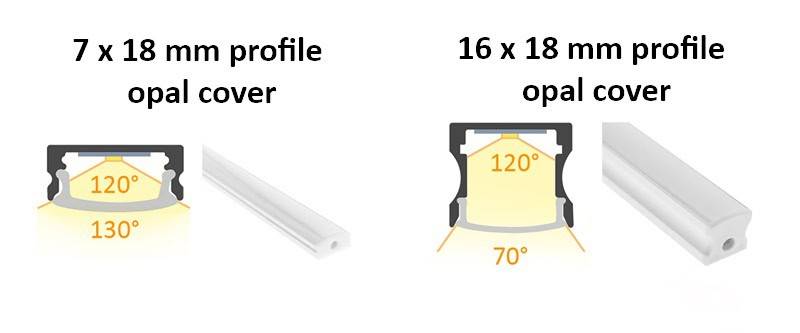
The proportions of the profile affect the beam angle. The higher the sides of the aluminum profile are in relation to its inner width, the deeper the LED strip sits inside it. In a narrow and tall aluminum profile, the inner walls cut off part of the light, resulting in a narrower beam.
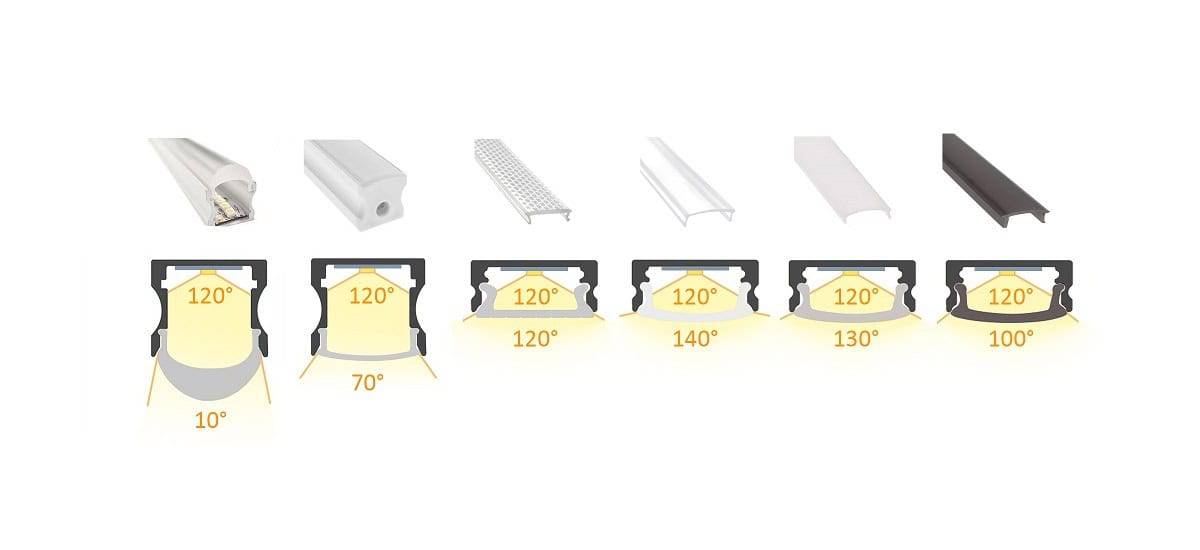
The type of diffuser affects brightness, beam angle, and the overall appearance of the solution. A clear diffuser allows the most light to pass through, but it may cause glare. In addition, the LED strip remains visible, which may not always be visually pleasing.
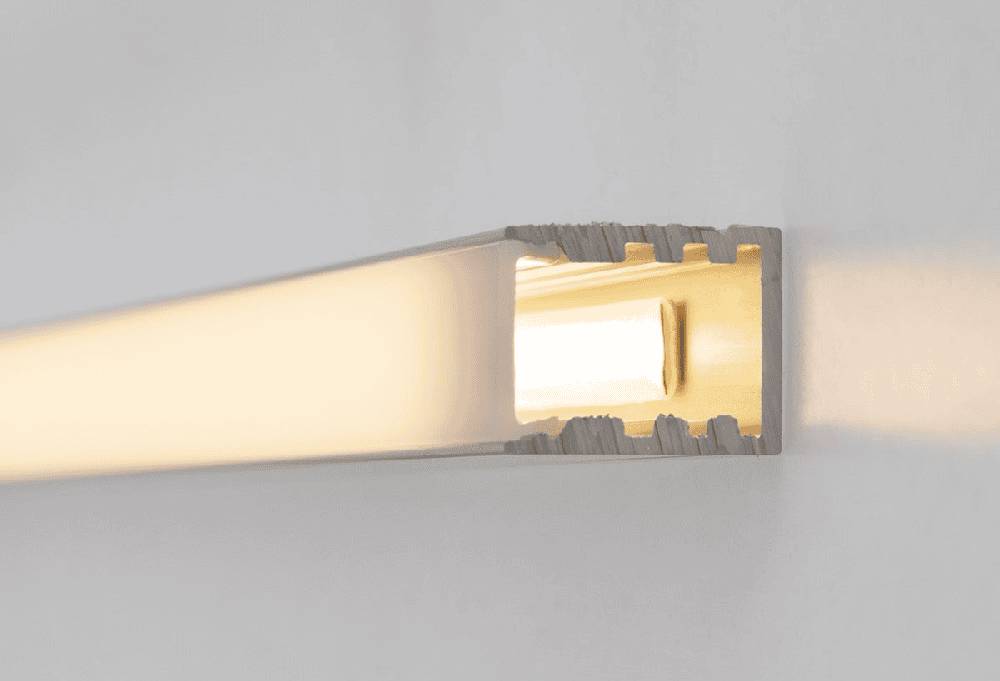
Aluminum profile proportions
An LED strip profile can narrow or otherwise alter the light distribution of the strip, as the inner walls of the profile block light rays spreading to the sides. The beam angle indicates how widely the light spreads as it exits the profile.
As a reference model, the geometric maximum beam angle can be used. This depends on the relationship between the profile’s inner width and the height of its side walls. Based on basic geometric principles, it can be concluded that the taller the profile is in relation to its width, the narrower the beam angle of the LED strip will be.
Different diffuser types for aluminum profiles
The main purpose of the profile diffuser is to protect the LED strip from dirt and dust. The profile of the LED strip will not look as finished without the diffuser. The choice of diffuser affects not only the appearance, but also the amount of light that comes out ( transmittance) and the comfort (glare , softness).
Clear diffuser
- Pros: High light transmission (maximum light output), “sharper” light distribution.
- Cons: Can cause a glare, led strip shows through
- Typical: Produces sharper shadows. The beam angle generally follows the LED strip’s native light distribution, although the profile walls may narrow it.
Opal diffuser
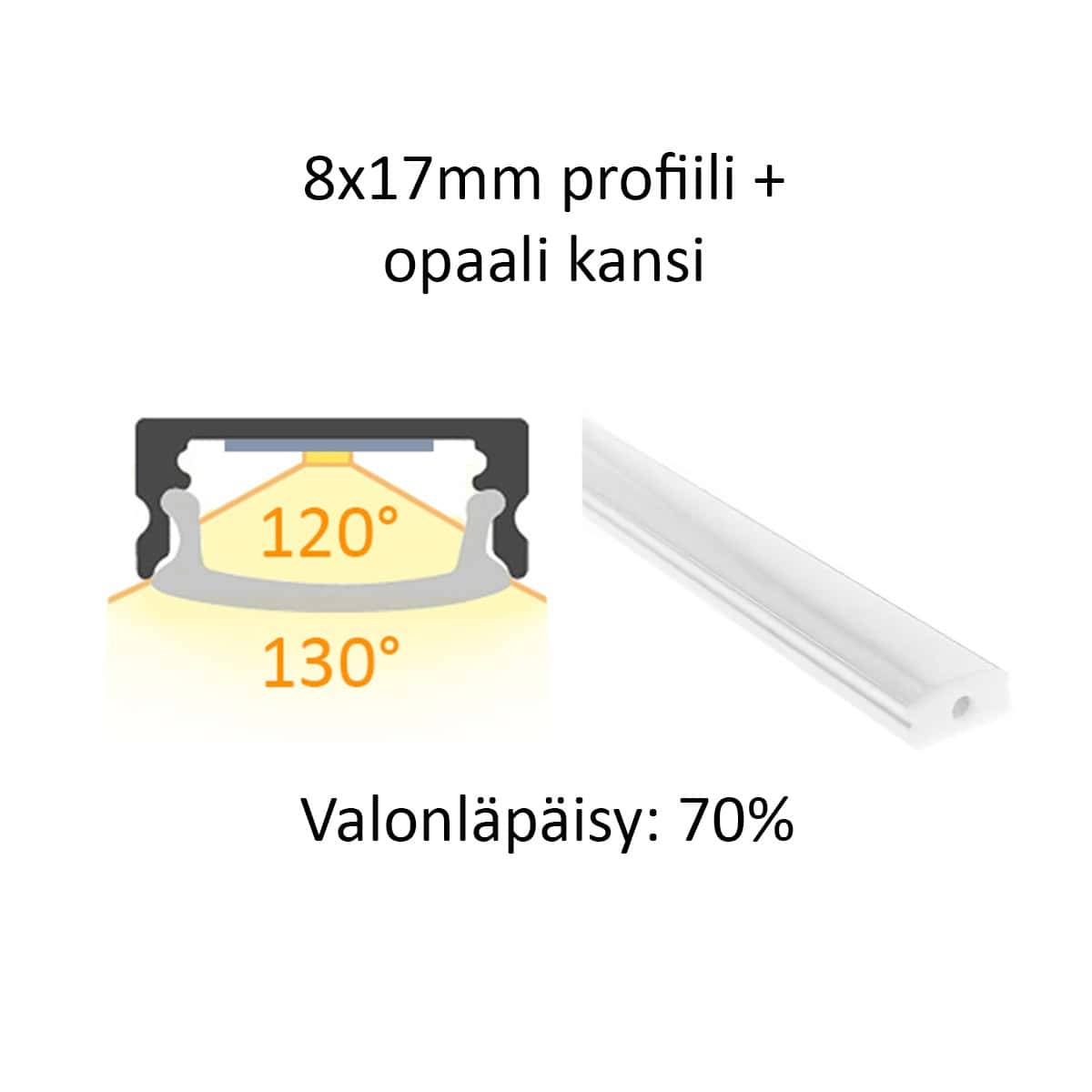
- Pros: causes less glare, softens the dotted appearance of the led strip
- Cons: lower light transmission (the diffuser reduces overall light output).
- Typical: soft light doesn't create sharp shades and it is found pleasant
Prismatic diffuser (microprism)
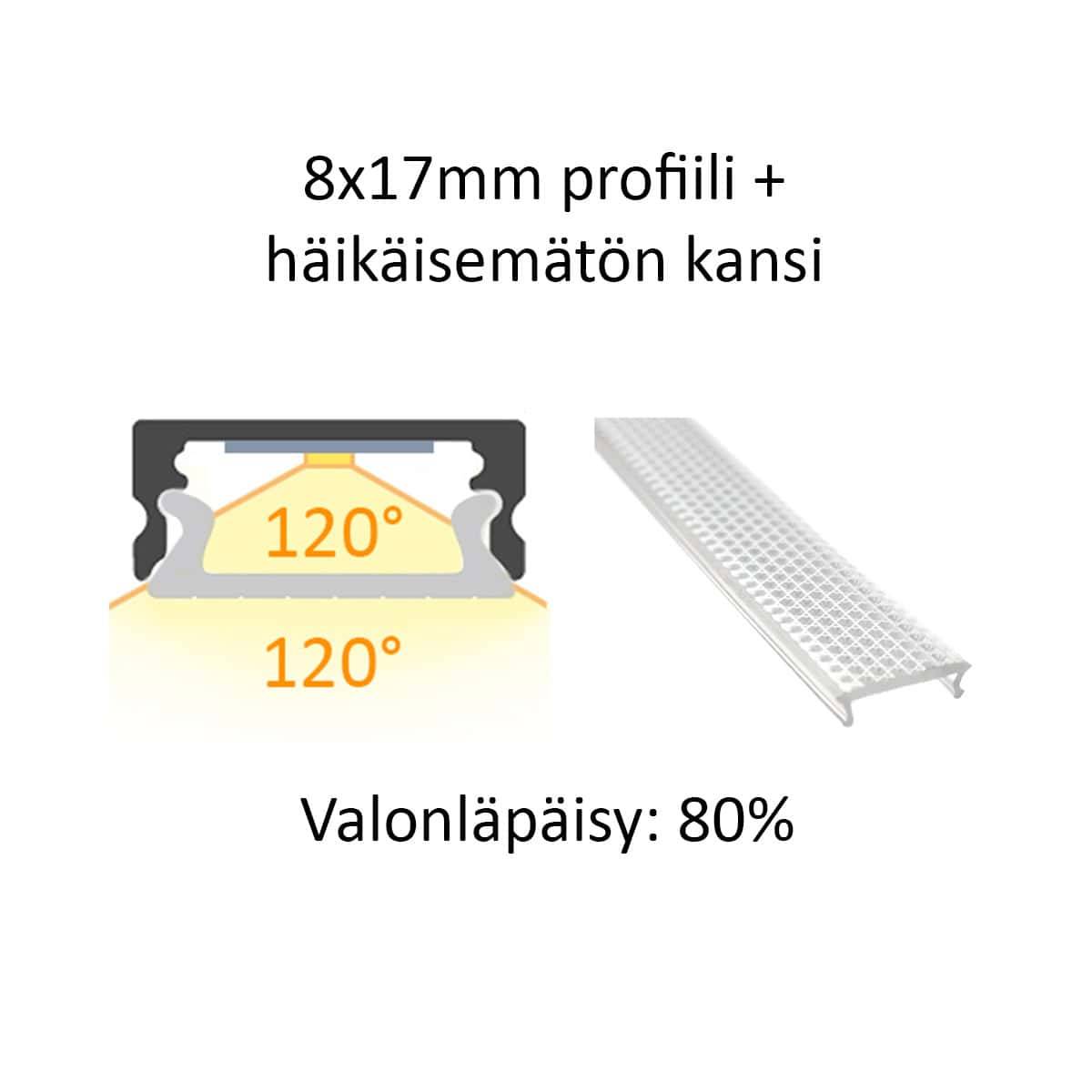
- Pros: effective glare control (reduces disturbing side glare), softens the dotted appearance of the LED strip
- Cons: may reduce light output and alter light distribution (depending on the design)
- Typical: Suitable for applications where the light is close to the eye, such as workstations. Most popular for task lighting in public spaces.
Optical diffuser
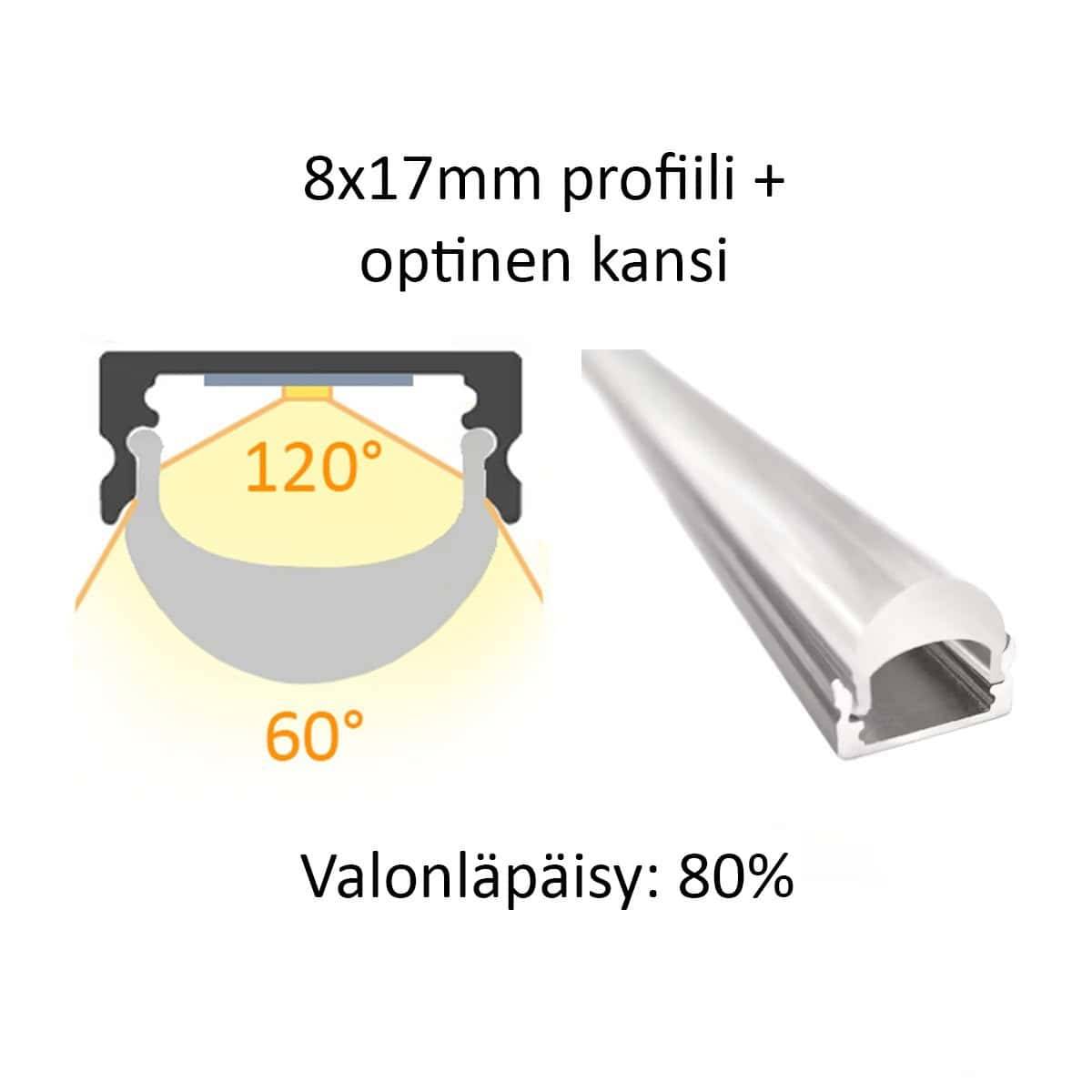
- Pros: effective glare control (reduces disturbing side glare), strong directionality (light carries further). Different beam angles can be achieved with profiles of different heights.
- Cons: The LED strip remains visible, and wall imperfections are emphasized
- Typical: Suitable for use in high-ceiling spaces, where this diffuser helps direct light further into the room
Black diffuser
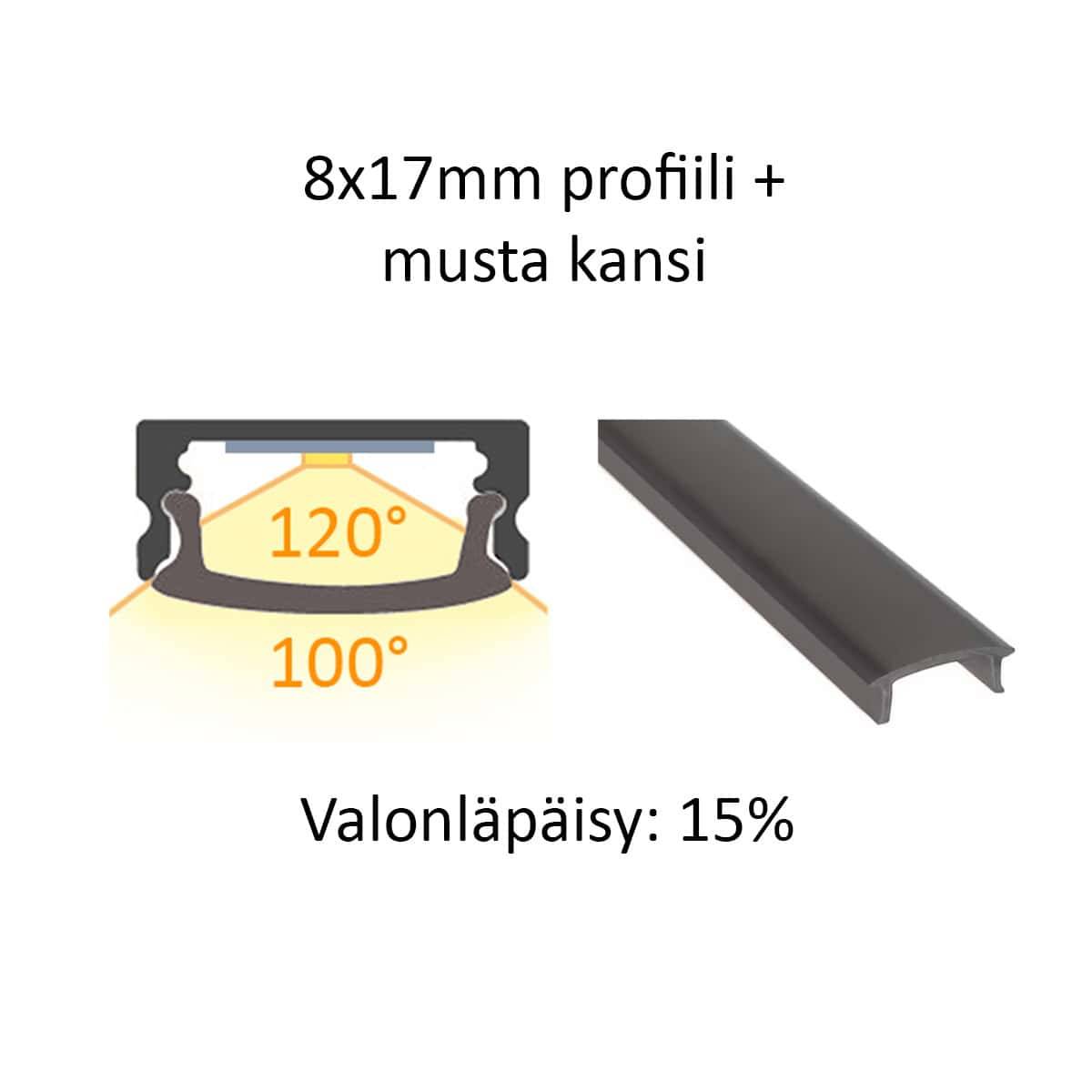
- Pros: invisible against black background when light are out
- Cons:
- Typical: Suitable for use against a black background in slatted walls, ceilings, etc., when the goal is more visual impact than pure light output.
Aluminum profile height and duffuser
Below is an illustrative table showing how the profile affects the beam angle of an LED strip. In this example, the aluminum profile is 12 mm wide, and the side wall height is either 5 mm or 15 mm.
| Profile height | Light type | Light geometry within the profile | Clear diffuser (85-90%) | Opal diffuser (70-80%) | Prism diffuser (80-90%) | Optical diffuser (80-90%) |
|---|---|---|---|---|---|---|
| 5 mm | wide light | 100° | Beam angle: 90–110° Glare: medium | Beam angle: 95–115° Glare: low | Beam angle: 90–105° Glare: low | Beam angle: 60° Glare: low |
| 15 mm | focused light distribution | 45° | Beam angle: 40-55° Glare: medium | Beam angle: 45-65° Glare: low | Beam angle: 40-60° Glare: very low | Beam angle: 30° Glare: very low |
The effect of the diffuser and profile on brightness
The packaging of an LED strip often states the lumens (luminous flux) per meter, which indicates the total light output of the product. However, users are often more interested in lux (illuminance) on the work surface or floor.
Lux is strongly influenced by light distribution. A narrower beam angle increases light intensity at the center, while a wider beam angle spreads the light more evenly but reduces the central intensity. Differences in beam angle partly explain why the same LED strip can appear different depending on the chosen profile and diffuser.
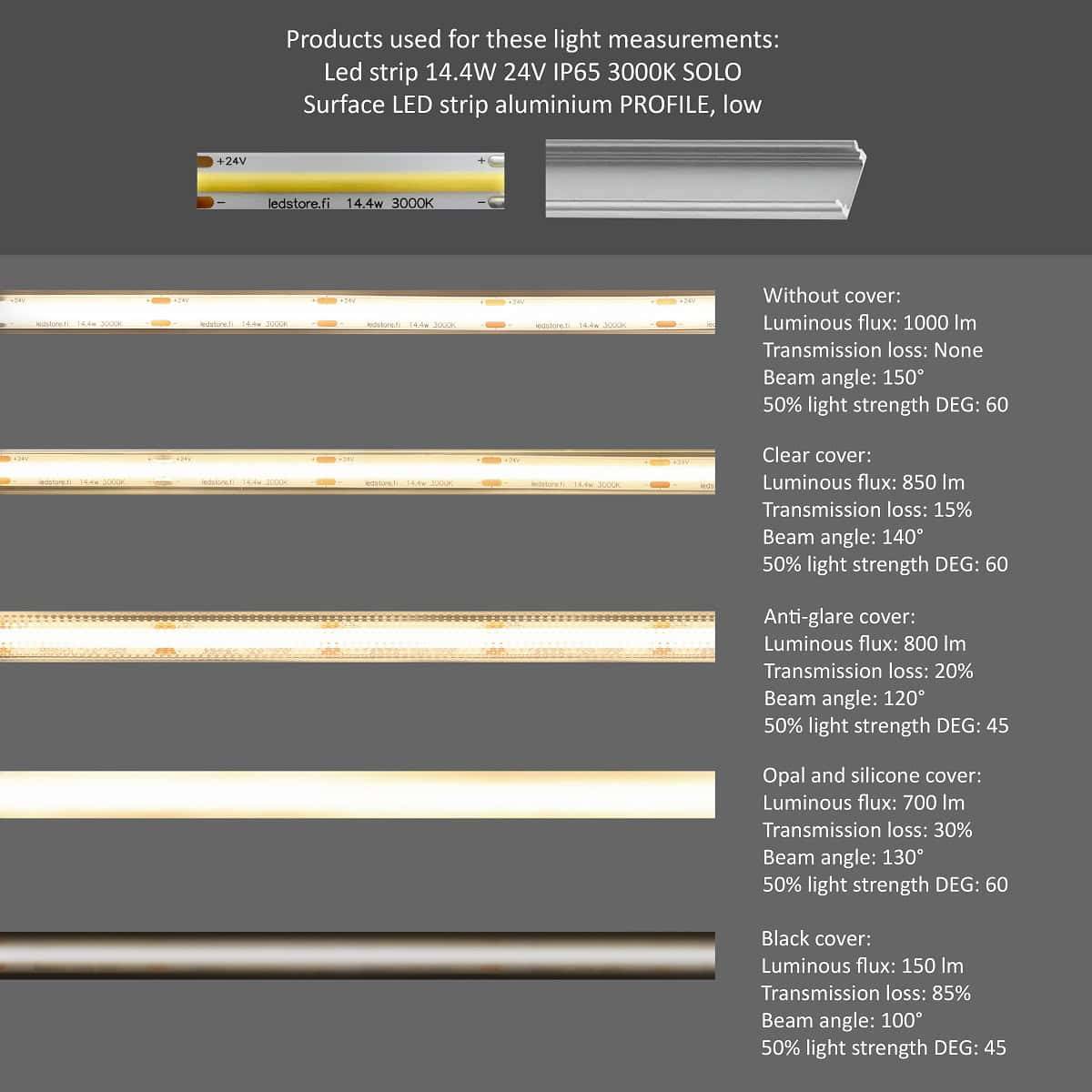
Example: Why narrow beam appear to be brighter?
If the same amount of luminous flux is directed onto a smaller area, the light becomes more concentrated — meaning the lux level increases in the central area and decreases at the edges. A brighter, more focused light can be achieved on a desk by using a slightly taller profile or an optical, beam-narrowing diffuser. The total lumens remain the same as with a shallow profile, but the light intensity is concentrated over a smaller area.
How the diffuser and profile influence glare
Glare occurs when a bright light surface reaches the eye from an uncomfortable angle. This is common in low-mounted lighting solutions where the light source is at eye level (such as workstations), in directly visible light points (e.g., staircases or forward-facing wall lighting), and when light is directed onto glossy surfaces (such as kitchen countertop lighting).
Glare control with profile and diffuser
- Choose a deeper profile: higher side walls narrow the beam angle → reduced glare
- Choose an opal diffuser: a softer light surface → reduced glare
- Choose a prismatic diffuser: controls high-angle light → reduced glare
How the diffuser and profile affect the visual appearance of the LEDs
"Hotspots" refer to the visibility of individual LED points or bright spots through the profile cover. Keep this in mind when selecting both the LED strip and the profile.
The visibility of individual LED points depends on the type of LED strip, the height of the profile, the type of diffuser, and the mounting method of the profile. In addition, dimming the LED strip increases the visibility of hotspots, which should also be taken into consideration.
How to avoid visible LED hotspots
- The greater the distance between the diffuser and the surface of the LED strip, the less visible the individual LED points will be. By choosing a deeper profile, you can achieve a more seamless, dot-free light.
- The more opaque the diffuser, the less visible the individual LED points will be. Choose an opal diffuser if you want to reduce the appearance of LED hotspots.
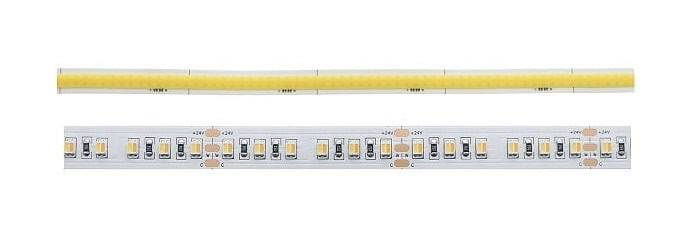
- Choose an LED strip with the highest possible LED density. SMD LED strips typically produce visible points, whereas COB LED strips create a more continuous, uniform light line. An LED strip with 120 LEDs per meter can appear uniform even in a shallow profile when used with an opal diffuser and without dimming.
- Countersink the screw holes if you are fastening the profile by drilling screws through it. Otherwise, the LED strip may sit slightly raised at the screw locations, creating brighter spots visible through the diffuser. You can also avoid this by mounting the profile using dedicated clips instead of screws.
LED strip profiles and covers – recommendations by application
Notes and tips on how to choose the right aluminum profile for different applications.
Kitchen worktop
By far the most common combination is a shallow surface-mounted profile with an opal diffuser. The profile is kept shallow so that its side remains visually discreet in the kitchen, while the opal diffuser helps smooth out the individual LED points as much as possible. Glossy countertops tend to reflect LED hotspots very clearly. Since the backsplash area is typically about 50 cm high, the light spreads well across the entire work surface.
- If the countertop is glossy (stainless steel or stone): choose an opal cover to prevent visible LED hotspots from reflecting off the shiny surface, and select your preferred profile (a shallow profile is the most discreet).
- If you want maximum output (matte countertop): choose a clear cover to maximize light output, and a deeper profile to reduce side glare and conceal the strip from side views.
Indirect lighting (light cove, enclosure, ceiling edge)
- When a soft light is desired: choose an opal cover to soften shadows, along with your preferred profile.
- When maximum luminous flux is desired: choose a clear diffuser or a directional diffuser.
Tip 1! When the space is high, use an optical diffuser to maximize the reach of the light.
Tip 2! You can achieve a clean edge for the dropped ceiling by using a profile installed on the edge of the drywall.
Shelves and glass cabinets
- To reduce glare: select an opal diffuser and a 45° angled profile to direct the light away from the line of sight.
- For a minimalist installation: choose an opal cover and a recessed profile that sits with the shelf surface.
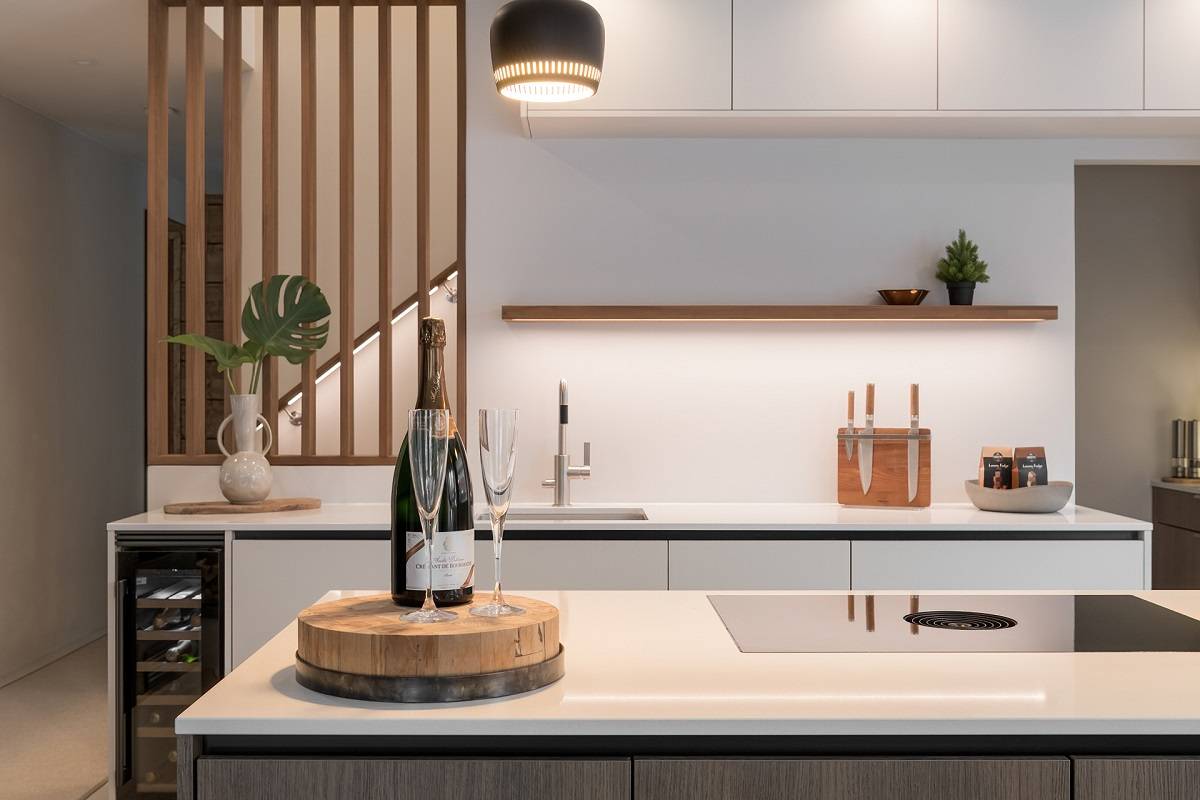
Tip! You can illuminate an open shelf using a recessed 45° profile that directs the light toward the back wall. This results in minimal glare and beautifully highlights the surface of the back wall.
Selection guide
Consider these factors when choosing a profile and diffuser.
- Is the light source visible? If yes, favor opal or prism diffuser.
- Is the light needed to spread widely or to illuminate the work surface below? Broad: lower profile. Down: deeper profile.
- Is the goal to maximize light output? Clear diffuser and sensible light direction.
- Do you want a softer lighting appearance? Opal cover and enough space between LED and diffuser.
- Is the surrounding environment dark or light? A dark environment often requires higher luminous flux or better light direction.
- Is it a work surface or workstation? Prioritize glare control: deeper profile + opal/prismatic diffuser.
- Want to ensure the outcome? Ask for IES/LDT files or verify with a pilot lux measurement.
Tip! Tell us about the intended use of the LED strip, the planned installation height, and the desired light level, and we’ll recommend the solution that best suits your needs.
undefined
Led strip light installation guides
- Led strip light cut-off - Led strip light cut-off and led strip light replacement
- Led strip light does not light - Why does led strip light not light, we go through the reasons
- Led strip light flashing - Why does a led strip light flash? There are many reasons and we will go through them all.
- Led strip light lifetime - What affects lifetime and why do other strips last longer?
- Led strip light mounting - How do I mount a led strip light indoors or outdoors? What needs to be taken into account?
- Connecting a led strip light to a transformer - How do I connect a led strip light to different types of transformers?
- RGB Led strip light connection - How do I connect an RGB led strip light to different control devices?
- Led strip light extension - How do I solder the joints? A little soldering guide for the beginner.
- Parallel connection of a led strip light - What is parallel connection and how to do it for a led strip light?
- Effect of Led strip profile on light - How does the profile height and cover affect the light?
Led strip lighting specialist
LedStore has been an expert in LED lighting and lighting design since 2010. We have our own product design, so our products are technologically state-of-the-art. Products have quarantee for up to 7 years. We also carry out lighting maintenance.
We focus on temperature-controlled and high colour rendering lights, so they work brilliantly and last a long time. We do around 500 lighting designs for our clients' sites in a year. Read more here or order a design. Did you know? LedStore offers lighting design from 169 euros for the whole house!
Made to measure Led strip lights
We offer a service of custom-made LED strips, i.e. custom-made LED strips in aluminium profile. Also installed.
Remember that we are always ready to offer our help to you along the way, by email (myynti@ledstore.fi) and by phone (045 251 4510). As always, feel free to share pictures of your own projects on social media using #ledstorefi on IG and ledstorefinland on FB. We love to see the cool things we do with our LEDs, and it helps to provide inspiration for those who are not yet sure about the power and awesomeness of LEDs.
Did you know that we already have over 3 500 pictures of our LED installations in our Gallery!
FAQ
Does an opal diffuser increase the beam angle?
An opal cover makes the light softer and perceptually wider, but the profile walls can still limit the side angles. The final result depends on how deep the LED strip sits within the profile and on the diffuser design (flat vs. domed).
Why does the same LED strip appear brighter in different profiles?
The light distribution changes when the profile changes: if the light is concentrated into a smaller area, the lux level increases at a specific point. In addition, the diffuser’s transmittance affects how much light exits the profile.
Does a COB strip appear as visible dots?
COB strips are very uniform, but a clear cover and an extremely shallow profile can still reveal individual points when the LED strip is dimmed. By choosing an opal diffuser, the dotted effect can be reduced. A deeper profile combined with an opal cover minimizes visible points the most.
Is a 15 mm side wall height always better?
No. It is more directional and often more comfortable in terms of glare. However, if the goal is wide and even general lighting or indirect lighting, a shallower profile is often the better choice.
Clear or opal cover in kitchen?
If the LED strip profile is visible, at eye level, or reflected from a work surface, it is recommended to choose an opal (or prismatic) diffuser: no visible LED points and less glare. If the LED strip profile is concealed and the goal is to maximize light output, a clear diffuser works well.
How much light is lost with an opal cover?
It varies depending on the material and surface finish. In general, an opal cover reduces light output more than a clear one, but in return it provides softer and often more comfortable lighting. Typically, about 20% of the light is lost.
What is prismatic cover and when to choose it?
A prismatic (microprismatic) diffuser reduces glare by controlling high-angle light. It is a good choice when the LED strip profile is visible and a more comfortable, professional-looking result is desired.
What is an optical cover and when to use it?
An optical cover is a diffuser that directs light depending on the installation depth of the profile. It is used in high spaces or when the goal is to project the light further toward the floor.
Can the beam angle be estimated by yourself?
As a general guideline, yes: a deeper profile (with higher side walls) usually results in a narrower beam. However, the exact value can only be determined through photometric data (IES/LDT) or by measurement.
Summary
The effect of the aluminum profile on light is greater than many expect. The depth of the profile affects directionality, while the diffuser influences softness, glare, and light output. By combining the right profile type with the right cover, you can improve visual comfort and deliver light exactly where it is needed.
