There are many needs in garment storage that require different lighting solutions. Here are some tips for wardrobe and closet design. It is a good idea to consider the lighting needs and the desired use of the space. In this article, we present lighting solutions implemented by our clients, from storage spaces to luxurious walk-in wardrobes.
Intensity of lighting in the wardrobe and closets
The most important choices for wardrobe lighting are whether the space is also used for dressing, and how the rest of the space is lit. In a space used for dressing and choosing shoes, for example, lighting should be at appropriate heights so that the shades and condition of the outfit can be assessed. As a detail, it is nice to be able to see stains, wrinkles and dents left over from washing, for example, as soon as you put your clothes on, rather than in the hallway when you are about to leave.
Clothes are always easier to find when they are lit by a light. Dark clothes in particular absorb light, as do dark wardrobes. Lighting overcomes the challenges posed by dark shades. Dark surfaces always require more light than light ones.
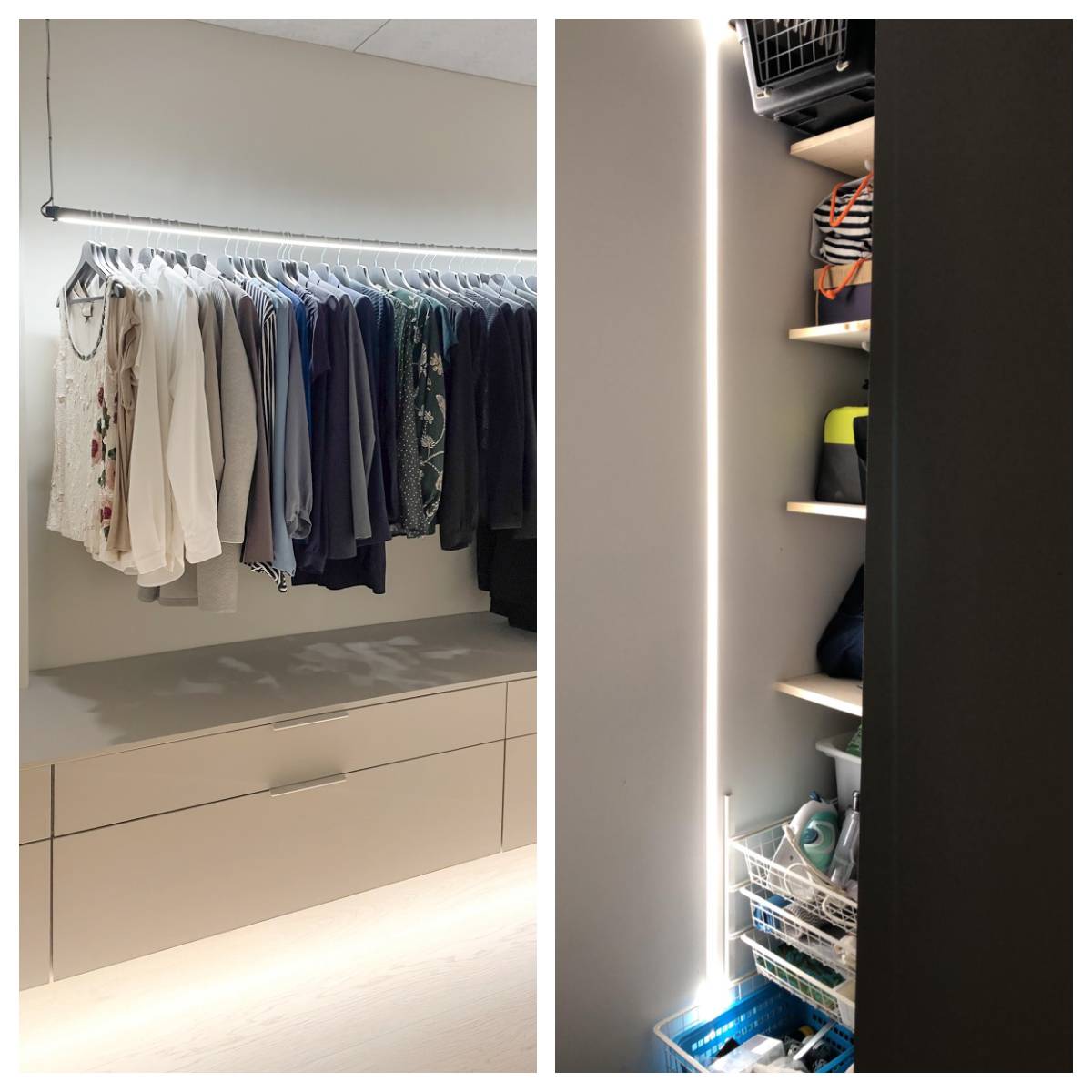
In the picture below, on the left, you can see the LED strip attached to the bottom of the roof of the garment in an aluminium profile. This solution brings light directly to where it is needed. The LED strip underneath the drawer balances the overall lighting, and helps with shoe selection, for example. In this case, the shade of both LED strips is infinitely variable.
The lighting levels recommended for close vision and reading are appropriate in the wardrobe when dressing and choosing clothes in the space where they are, and it is important to consider the matching of colours and materials, as well as the condition of the clothes.
Placing light in a wardrobe or closet
For wardrobe lighting, it is often enough, in the simplest terms, to design the lights in the room so that light can also reach the open wardrobe to make it easier to choose and find the clothes.
Often the problem with wardrobe lighting is that the light from the ceiling light in the middle of the room does not reach the corner where the wardrobes are placed. A ceiling light in the middle of the room provides general light to the space, but can leave the cupboards at the edges of the room in darkness. The solution may be to use a LED strip or evenly spaced ceiling lights.
The lights should be placed both on top of the cabinets and in front of the mirror. This way the light opens up between the viewer and the mirror and the lighting is balanced. Wardrobes with a sash on top of the cupboard can be illuminated by mounting an aluminium profile on the surface of the sash or in a groove milled into it.
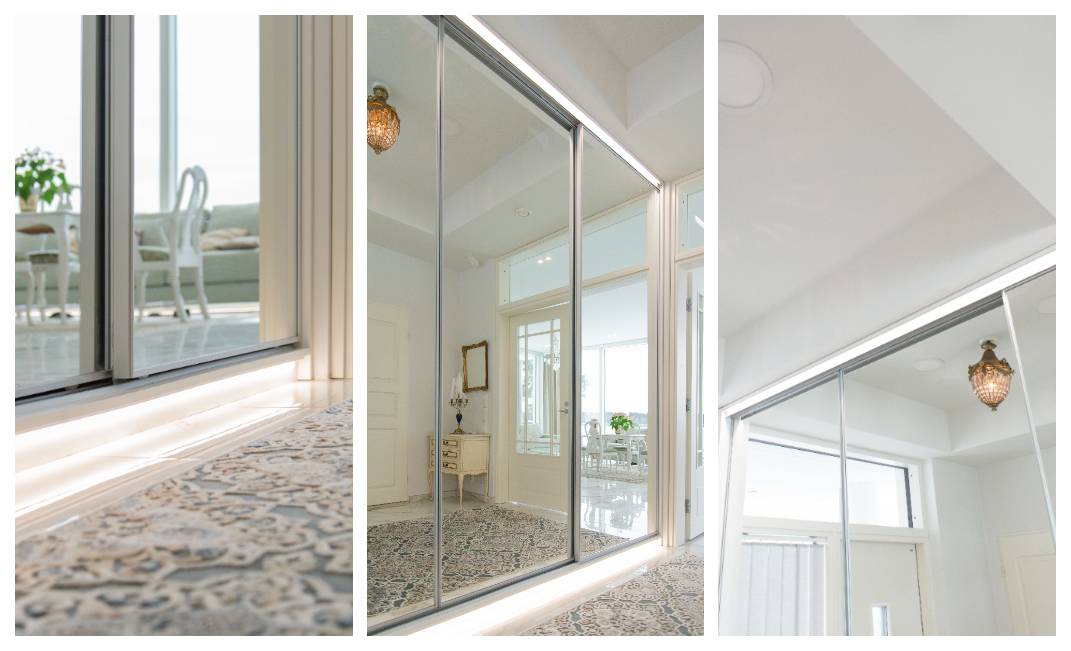
If the wardrobe is intended solely for storing clothes, you can choose to light it with a LED strip on the shelves only. In this case, you should at least put LED strips on the rack and plinth. For the shelves, if desired, a recessed aluminium profile can be installed vertically to illuminate all the shelves.
The LED light can be embedded in vertical or horizontal lines in the cabinet surfaces. Shelves can be pleasantly and glare-free illuminated with a shelf profile milled into the underside of the shelf. The profile allows the light to come in at a 45° angle and, when installed, can be directed towards the back of the shelf, thus avoiding glare.
The LED strip can be installed at different levels. It is a good idea to light the shoes with a LED strip installed on the lower level, for example, to direct the light from the bottom of the cupboard or plinth to the front or downwards. Clothes placed in a truck should usually be illuminated from above.
Colour temperature of the light in clothing and dressing rooms
The garment looks different in different lights. Tones and textures are accentuated differently depending on whether the ambient light is warm, neutral or cold. In some clothing stores, the fitting room allows you to vary the colour temperature of the light precisely because the shades of the garment change according to the temperature of the lighting.
At home, the shade of light in the wardrobe or dressing room should be either the same or slightly cooler than in the rest of the home. A cooler shade gives more contrast to the garment, making it more colour-perceptive and easier to see how the shades match. Warm lighting, on the other hand, creates an inviting atmosphere and pairs well with warm tones such as wood.
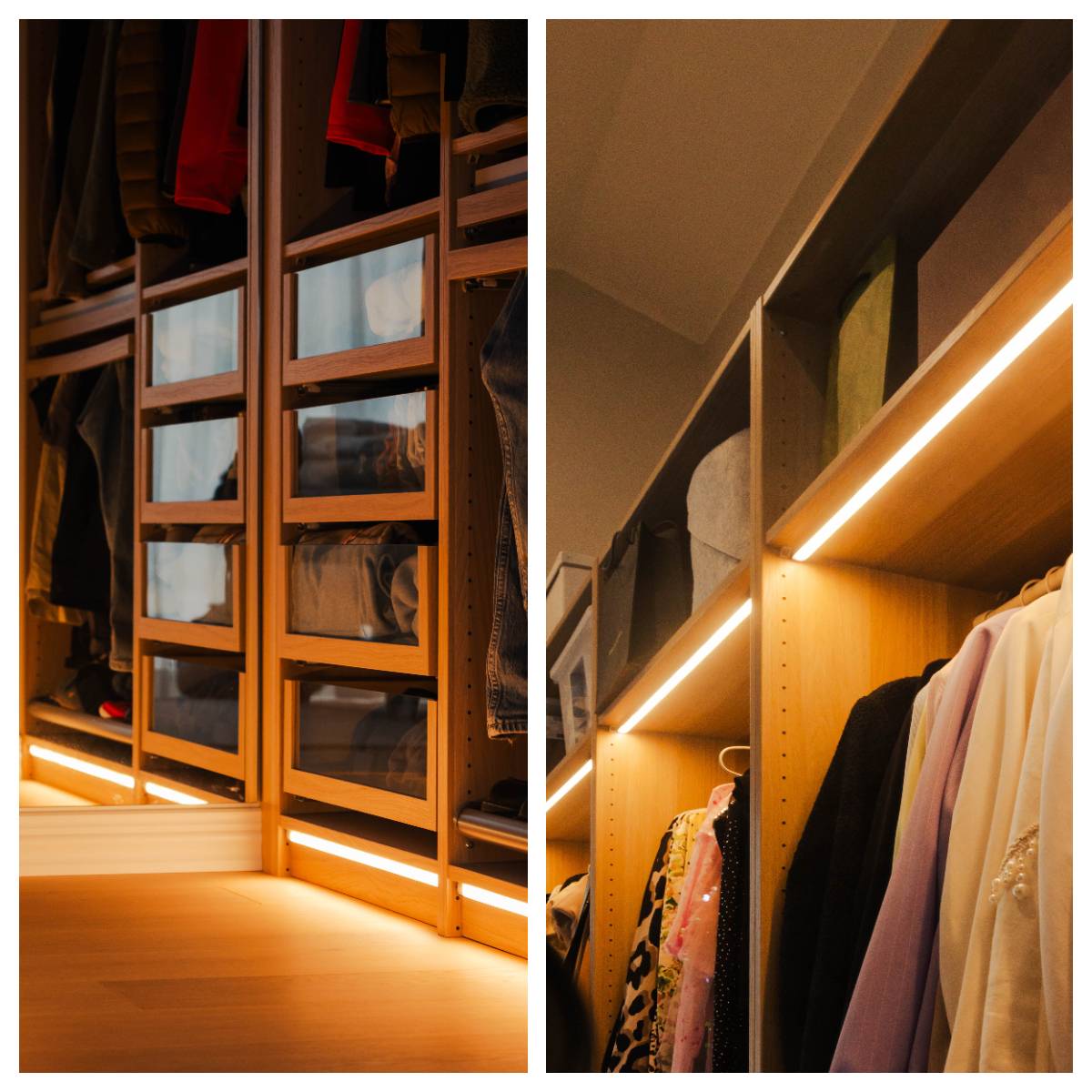
Colour temperature adjustable and dimmable lights are a good choice for dressing rooms. They allow you to adjust the mood and light level of the room to exactly the right level, according to your needs. Lighting is always a whole, and the lighting in the rest of the room should be taken into account when choosing the colour of the light in the hallway or bedroom wardrobe, for example. In the case of the above site, mobile-controlled smart lighting allows the lights in the whole house to work well together, as the colour temperature and brightness of the lights can be adjusted continuously.
Colour rendering of wardrobe and wardrobe lights
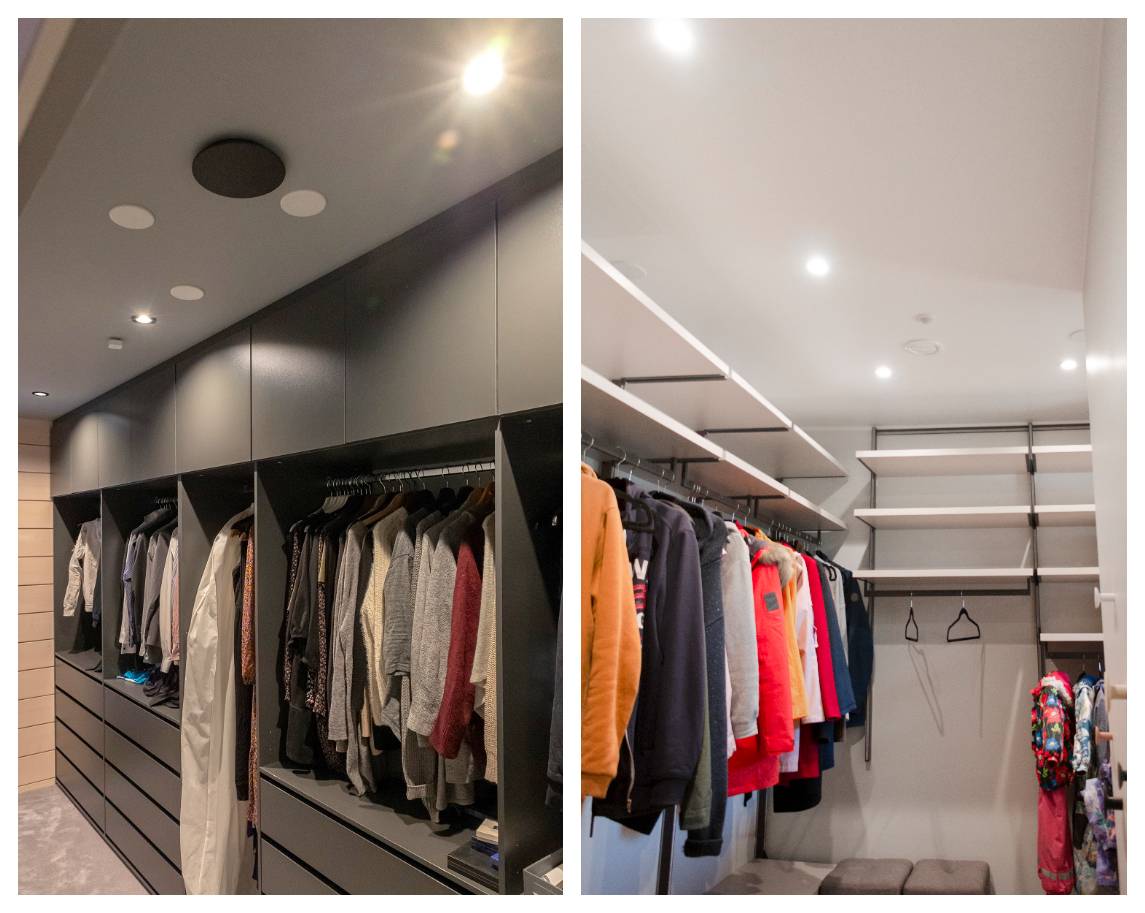
An important feature of LED lights is the colour rendering properties of the light. All the shades of a garment are best brought out when the lights are high colour rendering products. So-called full spectrum lights are the main focus of the LedStore range. A high CRI (Colour Rendering Index) brings out the shades of an object naturally, rather than bending shades towards, for example, green or blue-violet. In the pictures below, LedStore's 9W spotlights with a CRI of 97 have been used. This allows the shades of the clothes to come out as they are designed.
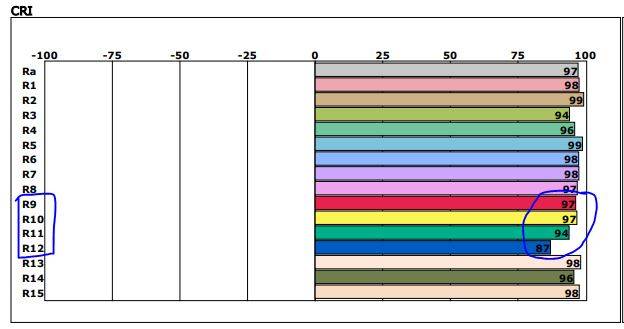
In the figure below, the results of the colour rendering index measurements are shown using LedStore's ModLed spot as a model. The graph shows that the selected reference colours R1-R15 have excellent reproduction, i.e. values above 90 in all but one shade. Some manufacturers present their color rendering index only for the first seven shades (R1-R7), resulting in a higher average CRI. The CRI is therefore the arithmetic mean of the R values.
It can be seen from the figure that the LED light can also steal shades from the target if the R-value of the colour rendering is negative in the measurement. The production of LED light aims at true colour rendering, as sunlight would naturally illuminate an object in daylight.
Wardrobe lighting as a decorative element
The choice of light is always an interior design issue. The more sensual and pleasant the light, the more versatile the use of different levels, surfaces, light tones, brightness and directions.
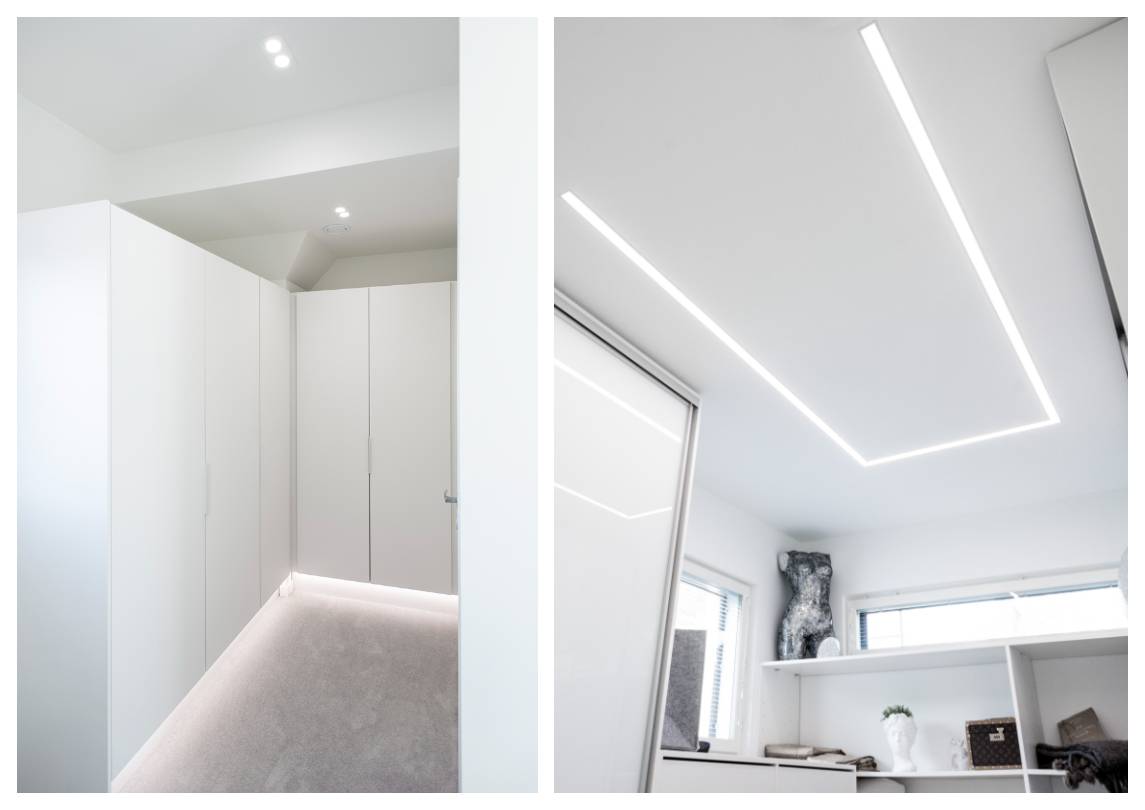
In the pictures below, on the left, the general light is brought in front of the cabinets with Double Cant spots , and aimed directly downwards, so that it also gives light inside the cabinets. An LED strip attached to the lower socket not only adds atmosphere to the space, but also brings the light to the floor border, for example to illuminate the shoes to be fitted. In the picture on the right, the LED strip is in a double-width, recessed aluminium profile, providing effective lighting and a contemporary look. The space is used as an office as well as for storing clothes, so good light output is particularly necessary.
Choosing clothes and getting dressed is also always about getting ready for something: going to work, a movie, a birthday party, a trip, a seminar or a cottage. You want to impress or dress to your strengths. In a way, choosing clothes is also a makeover, and the right lighting can help you do it. When the lighting is right, it's easier to find the right clothes, and it's easier to find the right outfit.
Clothes lighting in the hallway
Entrances are very often spaces with almost no windows, which makes them dark. It is also a good idea to consider lighting for clothes in the hallway. Wardrobes can be lit from the inside, for example, with motion sensor lights. This makes it easy to find the right outdoor clothing and avoids wasting energy by keeping the light on only when it is needed.
If you have an everyday or curated kitchen, lighting that is bright enough and correctly positioned will also help you keep your clothes in order and quickly find missing mittens, hats and boots.
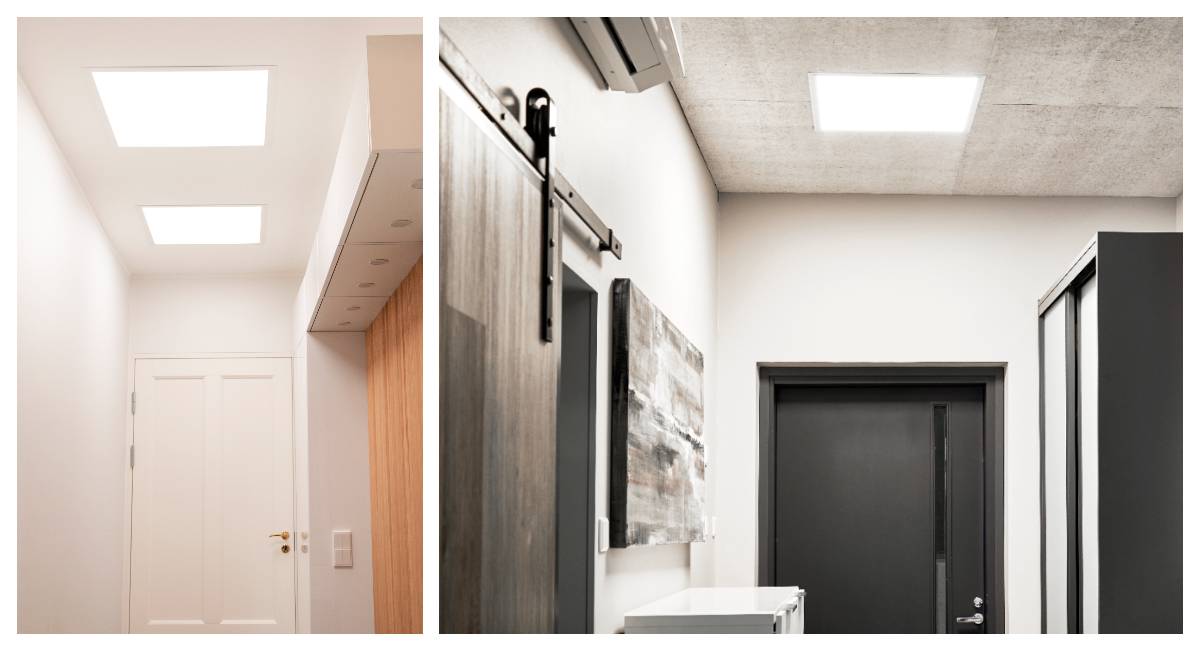
LED panel lighting is an efficient and economical way to illuminate hallways. Panel lights provide a wide angle of light, typically 110-120 degrees, which allows light to fall more easily across the entire hallway. For spotlights, all spots that open at an angle of more than 35 degrees are typically counted as general lighting, so when using spotlights, more than one light should be placed in the space. However, spots are a good solution for narrow and long spaces, for example, where their smaller opening angle is not a problem.
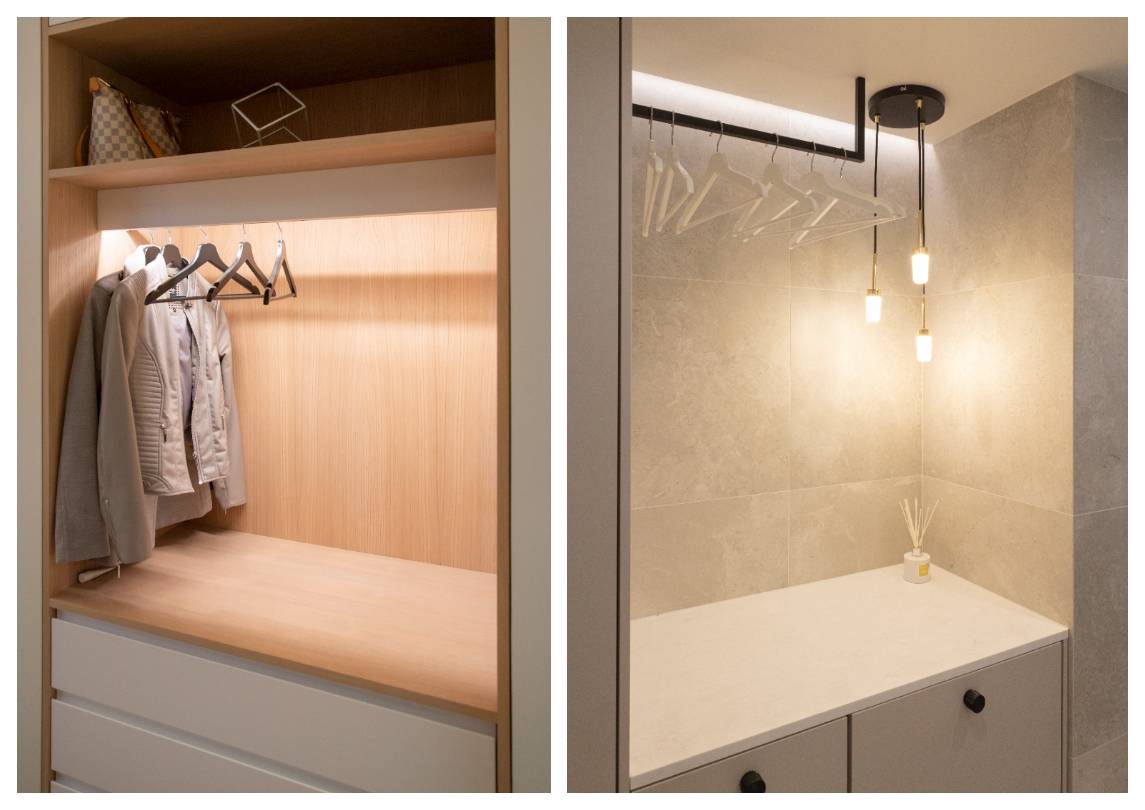
As a decorative element in hallways, you can also elegantly illuminate an open coat check. This solution brings both ease and elegance to the space. The lighting is realised with LED strip and aluminium profile. For such a more spectacular solution, you can choose to display your favourite clothes or any other impressive outfit, for example.
Take a look at our reference photos in the photo gallery, you will find more great implementations with LedStore products!
https://ledstore.fi/blog/category/referenssikohteet
Take a look below at the sample products for wardrobe lighting with flush-mounted profile, shelf profile and matching LED strips.
In the following carousel, spot and panel lighting for wardrobes.
Welcome to Lamppukauppa LedStore's showroom to explore lighting possibilities and design the perfect solution for your space. We serve a wide range of customers-consumers, resellers, and businesses alike.
You'll find us at Mesikukantie 16, 01300 Vantaa (Koivuhaka).
Feel free to contact us by phone at +358 45 251 4510 or by email at myynti@ledstore.fi.